ANOTHER AND ANOTHER READING
OF MARY JO SALTER’S POEM BLUE BABY
IN THE NEW YORKER, ANOTHER AND ANOTHER READING
--Darrell Sagness 1944-1955
--David Schweizer 1950-2024
I.
Yes, yes, no, no. But this can’t be.
But the years almost right. Dee Dee
and I--born in the same
North Dakota town--he
lived and then he didn’t, and now,
well, here he is with David Schweizer.
I’m sitting in the pew, sixth row,
early Sunday, Mary Jo Salter, listening
to Bell Choir practice, my wife Karen,
ringing, with Ruth Ann’s cello, carrying
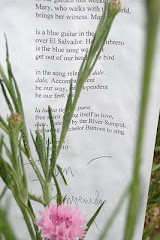
your Blue Baby, pages torn
out of New Yorker, December 8, 2025--
Yakima, Washington, decades
from Bowbells, North Dakota, still
Lutheran, dry land farm country,
NW corner, top soil covering
oil distilled from shallow seas.
I don’t know where you are this morning,
Mary Jo Salter, but strangely, you are
in the pew, present, your poem a part of me.
II.
Darrell, we called him Dee Dee,
Sagness lived on the farm outside of town
and I was a town boy, and my father
managed the Great Northern Grain
elevator, where his parents brought
their wheat. We were playmates,
and Darrell was a Blue Baby
and that’s how we knew him
playing marbles in front of school,
choosing sides for baseball out back.
Swinging wildly, choosing Darrell first,
choosing Darrell last, never
able to get it right, Blue Baby.
Something of his blueness in our selves.
III.
Blue Baby. Hole in the heart.
For the first time, Dee Dee
would run with the rest of us,
no longer blue, and fast. He would
hit, and we wouldn’t wonder
if he’d be chosen. And the operation
worked. Doctors in Minneapolis
opened his heart, stopped up the hole
where blood spilled into his face
and arms and legs. He came back
to us, and none of us were blue.
His mom called my mother,
Could Jimmy spend a day
on the farm with Darrell,
and the boys would have
the whole day to play.
IV.
And then he died. Just like that.
His heart wore out, they said.
After all the work it had to do
while he lived. This isn’t
the first time I’ve talked about
Darrell, Mary Jo. Your poem is salve.
Dee Dee and I sang in the Junior Choir.
We lived across from the church
rent free in the house owned
by the Great Northern Railroad.
Choir boys would be pall bearers
with his body. At practice,
laughter broke out from my body
stopping the hymn. Guffaws
bursting. I couldn’t stop
giggling. Dee Dee’s
heart stopped, and I couldn’t
stop laughing. I was ashamed.
We wore white robes and God gave me
buckets of tears, relieving
my terror. Like I’d been saved.
That day at his farm we sat
on the steel seat of the old tractor
and ate our sandwiches and laughed.
V.
There are tears in your poem, too,
Mary Jo. Thank you for Caleb’s
walking to the pulpit. Thank you
for the glimpses of Schweizer’s childhood
reading long books in bed,
for the saving qualities of costumes.
There would be an acting director
in my life, too, showing me how
to enter a room when I came back
from Vietnam. I would learn how
to wear a hat, how to dress
North Dakota as Louis Seize
without causing a fuss.
For your Blue Baby shows
how magnificent a heart might be,
how manly and flamboyant,
how the beating heart changes
the music and how bells ring.
Jim Bodeen
10 December 2025


 Posts
Posts


























No comments:
Post a Comment