Storypath/Cuentocamino: : THANK YOU NOTE TO UKRAINE
Storypath/Cuentocamino: : THANK YOU NOTE TO UKRAINE: A THANK YOU NOTE * Between narrative and closure Between the death of night and the beginning of day Between the Steppe and the Prairie ...

PAYING ATTENTION TO HATS AT THE HOMELESS SHELTER
PAYING ATTENTION TO HATS AT THE HOMELESS SHELTER
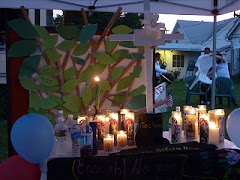
Last night at Camp Hope the Lutherans
Wore new aprons with the black cross, white rose, red heart.
Brought Calico Beans, Cole Slaw, and brownies
From family kitchens. Bottles of water
And enough for seconds. Martin Luther
Made this cross and rose himself—1520.
Good hats, what I look for.
I found the Vietnam vet baseball cap
coming through the line worn by a vet
In a wheel chair. No signs of war having distanced
Him from mobility. I ask first, where and when.
68 the first time. 69 and 70 the second time.
Came home— got out for a while and went
Right back in, re-enlisted. I ask where again
And he says below Cam Ranh and then the DMZ
At Cu Chi. Who with. 25th. Infantry, I say Yeah.
And MOS? Mortars. I was at the 85th Evac Hospital. Tet,
I said. He said, The second time up North. Yes,
I say. Cu Chi. After the bombing. He nods.
We evac’d boku from Cu Chi—not stopping.
Morale was gone by that time, right? Long gone.
That hat. Thanks for wearing it. Thanks for your time.
Welcome to Camp Hope. Thank you too he says,
And welcome home. I know the cooks
Who cooked those beans, I say. Seconds on the slaw?
Jim Bodeen
13 October 2026
THANK YOU NOTE TO UKRAINE

A
THANK YOU NOTE *
Between
narrative and closure
Between
the death of night and the beginning of day
Between
the Steppe and the Prairie
The
grandfather and the boy
Why are those crosses there, Grandfather?
Between
the old story and the new story
I
come from the country place to the city street—
Rural,
a country boy.
We
didn’t have shirts like the one I’m wearing—
Rich
red thread, hand-embroidered,
High-neck,
tie strings with tassels,
This
deep rich Ukrainian top soil gift
for
the body on the street—
My
clothes came from catalogs in Chicago.
We
had to leave when I was ten.
Seattle.
A city. Like Kiev.
I
wore those catalog clothes
Into
the new school.
City
kids had never seen anything like them—
Or me, either.
My
dad ran the grain elevator.
I
knew the slippery shimmer of flax,
And
how to chew wheat into gum.
I
walked railroad tracks
And
searched out Indian graves,
Smoking
tobacco-weed rolled in newspaper
Looking
for smoke signals in Midwestern skies.
I
am rural like Egorushka in Chekhov’s story.
I
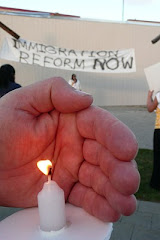
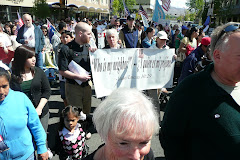
am a grandfather on the street carrying a sign
With
other grandparents carrying signs and we all look
More
or less alike, like we are all remembering
Someone
like Egorushka, the boy.
We
are all grandfathers asking the same question
About
the crosses. The same question.
Egorushka’s
the one riding on the hay truck.
They’re
taking him to Kiev, to school.
There
he will live with relatives and study.
I
know hay trucks and threshing crews.
I know accordion music.
I know war and something of peace.
This is the story that gives me access to others.
This is the sign on my face I carry into traffic
Wearing this beautiful shirt with red thread and
tassels,
A gift from Ukraine
Jim Bodeen
3 October—12 October 2026
· The embroidered shirt is called Vyshyvanka. This poem is for O.S. & K.S.

THERE IS ALWAYS ONE MORE THING
THERE IS ALWAYS ONE MORE THING
to praise, always.
Jim Bodeen
3 October 2026
LEARNING THE ROPES/APRENDIENDO LAS CUERDAS
LEARNING THE ROPES, APRIENIENDO LAS CUERDAS
—for Katie Lucille Pappas
Then someone came and tied rope to rope,
cord to cord, string to string, and drew
the water and drank. Then, everyone began to draw the water and drink.
—The Murmuring Deep, Havivah Gottlieb Zornberg
You ask me how it started. Well, it was
just a phone call to ask Miguelito to dinner.
—Learning the Ropes, Bill Ransom
I. CROSSING WATER
I’ve told this story before.
When I came home from Vietnam,
university students ask two questions:
Did
you kill any babies? Got any dope?
The drama teacher takes me into the hall
and shows me how to enter a room.
Call this one drawing water.
These are the dark sounds of Cante Jondo
in the lands of Lorca and Machado.
Of Paz, Guadalupe and Sor Juana.
Malinche and Cervantes are your grandparents.
Mine, too.
Grandpa, what did you do in the
war
It may be that your classmates
don’t want to give up
their cultural secrets.
Don’t be misled.
You have your own practice.
Your own agenda.
II. PARALLEL INQUISITIONS
Inheriting silence with its brutal weight
in the shadow of Lorca’s ravine.
Maybe go the other way
and take a bus to Ronda. Camarón de la Isla,
greatest of all. Flamenco singers. Carrying
a nickname! Given to him by an uncle!
His name José Monje Cruz.
The universal wound, lucha con el duende.
Duende wounds. Without the possibility
of death, no duende, the wound,
Camarón de la Isla. ¡Escuchiste!
Always open. Malinche and Cervantes.
A bit of the pocho in me.
Who marries who is the labyrinth.
Inner ear walking like we walked in Yakima
after picking peaches in orchard solitude.
Violent shadows alchemized.
Rilke arrives in Ronda stuck,
and he found it—inspiration. When the bus
driver opens the door
it’s your walk.
III. ALGUNAS NOTAS
No tiene ni pies ni cabeza
No me cuadras
Mucho ruido y pocas nueces
Pura boca
Solo tiene suelto
Coger el ritmo
Hacerme con el mundillo
Quedate con el cambio
Dar una de cal y otra de arena
Novatada, no estas super verde
Lanzar la piedra y esconder la mano.
A mi no vaciles
Corta el rollo
Basta ya
No me comas la oreja
Espabilla.
Espabilla y haz tu parte
IV. THE TRIGGER FINGER HAS A LISTENING EYE
He collided with the place, his encounter his.
The prayer in darkness being the essential prayer.
Spain asks only this, make fire.
Raw danger’s sacred breath. And breathing.
Dancing connections human, word-raw.
So raucous, purity becoming us.
This act of living, our full color defiance
between Guadalupe and Malinche.
She collided too. Which she me?
Taking poems to the prison
the psychologist said,
It takes 26 days for them to get real.
Anybody can pretend for 26 days.
But there’s something gonna happen tomorrow.
V. LLEVANDO MACHADO EN LA MOCHILA
WALKING THROUGH SPAIN,
THE GRANDDAUGHTER BECOMES AN ABRECAMINOS
Caminante, no hay camino
Se hace camino al andar
Antonio Machado
Machado in your backback.
Su mochila. The things you carry,
walking. Your walk. Wonder
in the long night burning every map.
And Lorca’s Duende—not only
the death drive, but the pathway to healing.
All Cante Jondo is flamenco,
but not all flamenco is Cante Jondo.
You’re walking in Málaga.
Find the Café de Chinitas, Lorca quotations
on the walls. Take pictures,
send some. The cross-shaped alley way
built for 17th Century nuns.
You’re in a temple that looks like a classroom
with scuffed-up floors and bad light.
Everybody’s on the road to find out--
everybody is.
Machado’s walk makes you wonder--
make you new? What’s
around the next corner? Through
that door. When your Uncle Tim
was 15, he and I flew to Yucatán
and worked our way north
through Chiapas on bus. Boarding
a shuttle in San Cristóbal De Las Casas,
I looked into eyes of campesinos
heading straight to asparagus fields.
Hey, Gringo, I have three wives.
Una aquí, y dos en Tejas!
--Lo siento, Amigo. Ud tiene
muchas problemas. Only so many
ways to say it. Years
later on graduation night, dressed-up,
a Mexican student,
calls me out, smiling, ‘Qué
Muñeca! One way again—
—Muñeco!
Katie—you ride the bus
with the chaos of the road
and your mother’s courage.
You’re 20. Your mom, 22,
seriously ill, alone in Morelia,
hospital phone calls, limited Spanish,
--Ella
necesita operación para salvar
su vida. Your mother hangs up the phone,
walks herself into surgery.
You don’t have to do these things,
but you carry them in your being.
The darkest rooms are full of light.
CODA
There’s room in your backpack.
Remember that stone you brought me
from Arizona that looked like
the Sangre de Cristo mountains.
I cut a wood round, polished
and hand-rubbed for the patina.
Suiseki sensei calls it a daiza.
Where your stone rests in the garden.
We’ll look at it next year
when you return.
What I did is what I do in these poems.
Love you—Gpa.
Jim Bodeen
16-21 September 2026
Subscribe to:
Posts (Atom)

 Posts
Posts