NOTE TO PASTOR JILL ROSS WITNESSING AT THE BORDER


NOTE TO PASTOR JILL ROSS WITNESSING AT THE BORDER


    We lift up our eyes to You in heaven,

    O God of eternity, wishing we were poorer,

    more silent and more mortified.

            Thomas Merton, Dialogues with Silence


Happy Birthday, Pastor Jill.

Thank you for praying for me.

You’ve always been a monk like that, praying for others.

You make things easier.


And Merton.

When I found him in 1968, just back from Vietnam,

I didn’t know his body was already gone.

I wouldn’t know for certain

until after I was sure he’d gotten

that photograph from the other side

of the mountain.


For those looking for that photograph

is something I pray for. I was reading Four Quartets

with Brother David in the garden.


I wanted to say these things without using words.

I didn’t know how. All I had was Happy Birth Day

Two words. Hyphenated. I didn’t know about the bombs

when I went to bed. Lucky for Merton.

I thought maybe you could feel my breathing.

Or maybe, maybe, you knew I was walking

by hearing my footsteps.


Jim

2 March 2026

LOVE IN 2026 AND BEYOND


LOVE IN 2026 AND BEYOND

               for Barb and Cragg

        My hope is in what the eye has never seen.

        Thomas Merton, Dialogue with Silence


So many flowers.

So much paint.

So much material to work with.


Silk butterflies from Japan.


So many ways to remember

Harriet Powers. So much gathered

testimony. So many threads.


Barb, Karen, Harriet.

So many mothers of beauty.

The yellow iris bulb is a world.


Jim

5 March 2026

THE GIFT OF LUCILLE CLIFTON


THE GIFT OF LUCILLE CLIFTON

FOR PASTOR ANN MURPHY


She has the voice poets and pastors wish they had.

Doesn’t fall for seduction.

Born with 12 fingers and 12 toes,

revelation accompanies her birth.

Lucille Clifton appears in 1936

like Rosalee Tompkins on this post card.

She writes, feathers waving as we dance

towards Jesus. She’s with Phillis Wheatley,

who stamps these lines valid. Phillis

who gets her name from the slave ship Phillis.

Lucy, light, Luz Bel. My mother’s name.

Every time I read her poems I get an education.

She knows what women know. Knows men.

Knows these too are your children,

this too is your child. She knew early

what this was about.

She is always dangerous, Lucille Clifton.


Jim Bodeen

African-American History Month, 2026


POST SCRIPT FOR WIL HAYGOOD


POST SCRIPT FOR WIL HAYGOOD

        This was Vietnam. This was the war

        where it was time to speak one’s mind.

            Wil Haygood, Black Struggle in Vietnam and at Home


Mail had already been stopped when LBJ

landed at Cam Ranh Bay, Christmas, 1967.

Thank you for War Within A War, Wil Haygood.

I’m at the 85th Evac Hospital, Qui Nhon.

No mail. We’re together, talking shit.

We’re together 4 April 68, too. Dap.

My sign says, This way home. I’m

with the brothers, listening. It’s Tet.

If we survive this, they’ll send us back to the States.

Martin. Then Kennedy. Your credibility

dapping. What’s goin’ on Lou Rauls?

We’re evacuating 700 Gi’s a month.

Everything but the music. OK.

I’d say, Everything and the music.

634-5789, Wilson Pickett. Call me,

it’s a song. I’ve danced on the porch

at Motown. It’s closed on Friday nights.

A boy, relocated from North Dakota.

Your p.s. I hear your eyes on Hegseth.


Jim Bodeen

5 March 2026

REGARDING THE MIRACLE QUILTS OF GEE'S BEND

 REGARDING THE MIRACLE QUILTS OF GEE’S BEND


      “Strike the rock and water will come out of it.”

                                                      Exodus 17: 6

Moses would love the quilts from Gee’s Bend.

The commemorative stamps would would startle and silence,

he might drop the stone. He’d look at the meteor shower

in Harriet Power’s quilt, and call it scripture.

Two surviving quilts proclaiming,

Nothing is missing, calling for a third

tablet of stone. He’d wonder what else he missed

lost in God’s clouds. Gee’s Bend, The Pettway Plantation.

A husband’s work clothes cut out and sewn

for God’s glory. Go down, Moses. Strike

the rock and water will come. All right,

Moses, and that water came. Grant you that.

But Egypt, now. Tears in the water.

Quilts for God come from God.

And that Middle Passage, Moses.

Call that Middle Passage what it is.

Quilts from Gee’s Bend testify, but

call Egypt by its real name.


Jim Bodeen

9 March 2026


FRIDAY, 6 MARCH 2026, BEGINNING A NEW NOTEBOOK


FRIDAY, 6 MARCH 2026, BEGINNING A NEW NOTEBOOK

An art teacher, Jennie Smith, saw Harriet Powers' quilt at a cotton fair, and sought her out. Ms. Powers then, described each block to Smith, and because of that, we have Harriet Powers' words available to us today. This story documents how her grave site was rediscovered, and a new headstone dedicated. Harriet Powers's quilts are "documents in fabric." If you follow to her portrait, notice how she's dressed. She is "dressed up." And her clothes are also documents. That apron--look at it It's a uniform and a story. For instance, ask an indigenous woman about her apron, a Mexican woman about her "delantal." Its power and place. Look at the thread and imagery of the apron Harriet Powers wears. And in this image, below: Look at the falling stars recorded in cloth from 19 May 1780.

Harriet Powers lives now on the U. S. Commemorative Postal Stamp issued 28 February 2026, the last day of African American History month. Two of her quilts survive and can be seen in museums. Her story no longer confines itself to her quilts. I, too, survive as a fabric block of sorts. It is the first weekof March and my country has entered a new war, and the white chalk of days continues. On Thursdays I stand with others on a street corner for 30-minutes with my cardboard sign, shaped by taking apart a card box box. I have taken lines from Ukrainian poets and written them on the cardboard with different colored marking pens. I find the making of the signs a meditation, as well as a form of petitionary prayer.

My wife, Karen, is a quilter and fabric artist. She’s sewing today with others. I helped load her car with her sewing machine and materials. I put her fold-up wagon in the trunk to carry her machine. She’s working with little houses cut out on fabric. Each house is on a quilting square, or block, they call them. I made her a honey and peanut butter sandwich with some grapes for her lunch, and she sat down with me to eat her yogurt before leaving to quilt. She brought in two squares for me to look at. The houses have two windows, or two doors, they could be either, couldn’t they? I ask her. Yes, I guess they could. I intended them as windows, though. Flowers accompany either of them, be they doors or windows. They’re so colorful. They could be curtains, too! Yes. They could be.

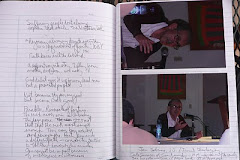
She drove off a few minutes ago. She’ll be gone most of the day, cutting out little houses on fabric, creating a neighborhood of fabric houses blocked out on cotton. I can only see so far, and can’t imagine what else will happen during this day of documentation, Of creation. I have a couple of hours myself to do with as I like. I began a new notebook this morning before walking, so I have that set up before me, and I hope to write a couple of post card poems, attaching different panels from Harriet Powers’ quilt newly created in the form of stamps. I will take them to the Post Office, where the postal clerk will provide me with a hand cancellation across the stamp in red ink. I find this last step wonderful. It makes me a bit dizzy. All of this, to tell the truth, makes me dizzy—more than dizzy.

Jim Bodeen

6 March 2026


ALI


ALI

Three years older

Ali was the poem we

thought impossible


Jim Bodeen

6 Februaary 2026

LETTER TO PHILLIS WHEATLEY WRITTEN WHILE LOOKING AT HER PORTRAIT ON THE BLACK HERITAGE POSTAGE STAMP ISSUED 29 JANUARY 2026


LETTER TO PHILLIS WHEATLEY WRITTEN

WHILE LOOKING AT HER PORTRAIT ON THE BLACK HERITAGE

POSTAGE STAMP ISSUED 29 JANUARY 2026


            ...blooming graces, triumph in my song.

            ...a faithful tongue…

            ...imagination is the empyreal palace of a trustin God

            ...Now here, Now there, the roving Fancy flies,

            till some lov’d object strikes her wand’ring eyes,

            Whose silken fetters all the senses bind,

            And soft captivity involves the mind.


            Imagination, who can sing thy force?


            …each noble path pursue… Phillis Wheatley


Jupiter Hammon’s letter addresses you

as elder, poet, peer, Christian, and slave,

both of you freed, and today we might add

immigrant—that, like everything between us


seems stretched. Hammon, born in 1711,

was 62 when your book,

Poems on Various Subjects

Religious and Moral, is published, 1773--


Phillis, you’re 20 years old. Both of you

wrote poems. You crossed at 31,

Hammon dies at 95. Starting with his letter,

he calls you pious youth in the first


stanza; and in the second one, he says

you might have been left behind.

You were 8 when you arrived

on the slave ship Phillis


receiving your new name.

Black writers, black women who insist

in living in ink, your fellow poet June Jordan

writes, have been writing about you

            Still, may the painter’s and the poet’s fire,

            to aid thy pencil and thy verse conspire?

            There in one view we grasp the mighty whole...

            ...twice six gates on radiant hinges ring

            celestial blooms in endless spring


            And may the muse inspire each future song!


            ...these shades of time are chased away…

            For nobler themes demand a nobler strain,

            And purer language…


for 250 years. You open 250 Years

of Struggle and Song, Kevin Young’s

Library of Congress monument to

African American Poetry, while


Jupiter Hammon’s letter to you

follows your poems. You, then and now,

are the Mother of African American

literature and I address you as such.


Hammon knows your poems

when he writes, ...adore

the wisdom of your God.

Adore, because you might


have been left behind. He believes

America is a good place to be,

making Christianity possible. In Stanza 4

he says it stronger: God’s tender mercy


            Inflame the heart, and captivate the mind…

            How he has wrestled with his God by night

            To shield your poet from the burning day:

            Calliope, awake the sacred lyre,

            While thy fair sisters fan the pleasing fire.

            And through the air their mingled music floats.        

            Spirits dart through flowing veins

            ...Fancy dresses to delight the Muse…

            ...frozen deeps may break iron bands...

brought you here, and it’s worth

all the gold in Spain. Hammon

is a bit overbearing—I’m an old man

at 80, and know that voice, he may be


jealous, too, he wrote sermons

all his life, he urges, Dear Phillis,

seek heaven’s joys. Neither of you

can see the mess we’re in now.


Michael Harper’s anthology’s here, too.

African American Poetry, 200 Years

of Vision, struggle, Power, Beauty and Triumph--

you and Jupiter Hammon, presented


at the beginning, and Harper gives us

your other visions: To the painter,

to the Morning, and Evening, and death,

on leaving for England.


You’re at the beginning of it all.

I’m looking at your stamp.

Black and white, ink on paper.

25 Million postage stamps of you.


I write as one who has been lifted,

if not saved, by black poets. I sit,

struck by your poems traveling

through time. There’s paper, and


Phillis, you’re holding a pencil,

where you’ve written,

Preface to my Second Volume.

Jupiter Hammon’s here too.


Following always, Jim


P. S. We’re here in the living room, together.

All of us. Here, in the all of it.


Jim Bodeen

29 January 2026


Phillis, we’re here in the living room, together.

All of us. We’re here, in the all of it.


Jim Bodeen

29 January 2026


ON THIS THIRD DAY OF FEBRUARY, 2026, JAMES BALDWIN, HIS STAMP AND OUR TIME


ON THIS THIRD DAY OF FEBRUARY, 2026,

JAMES BALDWIN, HIS STAMP AND OUR TIME


Opening the drawer on the coffee table

where commemorative stamps are kept—ones

I can use, that I hold out for me—not

the ones in sleeves archived for grandchildren,


looking for the James Baldwin 37-cent

commemorative I attach to post card

poems as gifts for friends, this Baldwin

stamp came out on 23 July 2004,


before Forever stamps debuted

in April 2007 (eliminating the need

to purchase stamps in small denominations

to mail a letter), the first Forever


being Liberty Bell, I’m re-reading Baldwin

during Black History month. Listen to him

on Martin Luther King, Jr. “...to state

it baldly, ‘I liked him. It is rare that one


likes a world-famous man—by the time

they become famous they rarely like themselves.’”

This drawer of loose stamps is a treasure

chest of Black history: Ernest Gaines,


August Wilson, Edmonia Lewis, Harriet Tubman,

Tousssaint, Gwen Ifill, Ella—Waters and Fitzgerald--

Arturo Schomburg—Oh, man! Baldwin

wrote this in 1961, “King cannot


be considered chauvinist, what he says

to Negroes he will say to whites, and what he says

to whites he will say to Negroes.” Baldwin

is five years older than King. Until King,


in Montgomery, Baldwin writes, the minister

could not change the lives of hearers: “All

they came to find, and all that he could give

was sustenance for another day’s journey.”


Baldwin again, bluntly, “...the white manuscript

on whom the American Negro modeled himself,

is vanishing. This white man was, himself,

a mythical creation of men who have never been


what they imagined themselves to be.” We’re

not done here, are we? The Baldwin stamp

matches a portrait of him, circa-1960

against a backdrop view of Harlem


where he grew up. So much story

in a square-inch stamp. One more Baldwin

gem: “Europeans refer to Americans

as children in the same way American Negroes


refer to Americans as children...so little experience...

no key to the experience of others.” To

become oneself. These stamps help me

in my studies. To stamps in these times, saving


for grandchildren Grandpa’s stand: February, 2026.

This 37-cent postage stamp, added to an envelope

requiring 71 cents postage, pure and extra,

political, with hand-cancellation, through the mail.


Jim Bodeen

3 February 2026


FROM THE KITCHEN TABLE, JANUARY, 2026, YAKIMA, WASHINGTON--TO THE WASHINGTON CATHEDRAL, 31 MARCH 1968--LETTER TO PASTOR MARTIN LUTHER KING, JR.


FROM THE KITCHEN TABLE, JANUARY, 2026

YAKIMA, WASHINGTON—TO THE WASHINGTON CATHEDRAL,

31 MARCH 1968—LETTER TO PASTOR MARTIN LUTHER KING, JR.


             PART II


I. After the Sermon


You’re greeting the congregation, Dr. King,

taking our hands as we file out,

and we’re slow go not letting go of your hand.


This is your last public sermon

and this time we get it.


You’ve just stepped down

from the Canterbury Pulpit

Cathedral Church of St. Peter & St. Paul,

commonly known as Washington Cathedral.


March 31, 1968.

           ●

15 March 2026


II. Dear Pastor King,


I’m going to call you pastor, Dr. King.

That’s what you are for me, Pastor King, my pastor,

and I’m coming from the pew. I, know, too,

your titles, and the epithets that come with you,

and I’m still inflated by it all, from the Canterbury Pulpit

to your place at the right hand of God.


We’re getting ready for your birthday.


I’m walking before breakfast listening with hearing aids.

I’m 80, and no longer need to embellish. You’re telling us

about Rip Van Winkel, how he slept for 20 years,

sleeping right through a revolution.

King George III. We have other worries now--

Yakima, Central Washington State, it’s cold, and the ink won’t run

in my pen. I take notes on the recipe card while walking. For the Pecan Pie

I made for your birthday.


On this day, end of March, 1968,


I’m 22 years old, 85th Evac Hospital, Qui Nhon, Viet Nam

during the Battle of Tet begun on New Year’s lasting until

Johnson finally stopped the bombing. I’ll pick up there.

It’s my job to get our guys off choppers and onto planes

and out of the country to Japan, Philippines, or, closer to you

in D.C. at Walter Reed—Ft. Sam Houston for burned bodies.

I can relate to what you say about just to have crumbs,

about the appalling silence and indifference of good people.


I didn’t hear it then. I did, but. It wasn’t exactly chronological.

I had a teacher in high school, 1963, who told us, broke your story--

but I didn’t know, then, you wrote that Letter from Birmingham Jail,

then, 16 April 1963. No, I didn’t. Then, that, that I didn’t know.

When I did know, later, I put your Letter from Birmingham

into my New Testament. It’s right there next to Paul’s letters.


But in March 1968, I’m at the 85th Evac, a GI.

And I’m bunkered with medics and we’re black and white,

and we’re brothers, as you say from The Canterbury Pulpit,

...standing in brutal solidarity...young black men

and young white men, fighting and killing

in brutal soldarity, that is us.


And in a few days,


when you are murdered,

that’s where we are, and that’s where I am.

And when you are killed, GI’s in Vietnam,

we’re all wondering what just happened. You say,

Dante couldn’t imagine it. We’re using other words,

talking in GI. And writing home. Writing home.

Brothers in Black and White. And that’s how

I remember those days—and Bobby Kennedy’s

still alive. No confusion there. “They send us

to Vietnam, and when we’re done here, they’re

going to send us back to the United States.”


What I won’t know for years,


Dr. King—I do slip in and out of those titles,

is that this is what’s in my letters. We’re together

in that hospital, one in bunkered solidarity, telling

this cruel joke on ourselves. “That’s what’s going

to happen.” It’s in my letters to Karen. When I found

those letters she saved, I felt redeemed. You say

in that last sermon...and when they come home

they can’t hardly live on the same block together.

Being part of the cruel joke is part of our blessing.


Dr. King, what I want to tell you

in this letter is this. We’re in the same pew.

We’re in the same block, too. Always have been.

It hasn’t been like this for everybody,

but that’s how it is here, with me, with us.


III. HOLDING ON TO PASTOR MARTIN’S HAND


I’ve been holding onto this one over 50 years, Pastor Martin.

I’m conscious of the man beside me, I am,

but this time, not my time, but we’ve been in line

a long time. I’m talking to you in a letter

and I’ve got grand-kids, grown now,

and I’m talking to them through you,

in your words, through that pulpit over time,

and then there’s my notes from what you

said on that toilet paper from Birmingham Jail.


I’m just coming to that,


They can hear that direct from me.


Dr. King.

Yes. That sermon.

That’s life.

Life in that sermon

that’s not going away never.


Jim Bodeen

15 January 2026


KATE AT 20


KATE AT 20


Sometime in December I began

thinking about your birthday like this,


Damn, Kate’s gonna be 20,

and here we are. Yesterday


a book of poems came

in the mail. Second


Childhood. I ordered

it for myself. Marie


Howe says she’s decided

not to grow up. I’m following


in her footsteps, Kate.

You’re the first one


I’ve told. Grandma

sewed you a cover


for a new sketch book.

You’re an artist


with an eye for eyes

who thinks in geological


time. Called

to all this! You!


What kind of child

would I be


if I tried to give you

advice on your birthday.


Gpa

21 January 2026

LATE JANUARY MORNING PRAYER


LATE JANUARY MORNING PRAYER


                         for K. M. And Martin Luther King, Jr.


We pray this morning for the clergy

on the streets of Minneapolis,

            and we pray for all on the streets

            all over the world.

We pray for the monks

praying for us,

                       and we pray, in particular,

                       for our own ELCA Lutheran clergy

          on the streets

                                in Minneapolis

                                and St. Paul,

                       and in pulpits all over the world.


We pray for all of of them,

                                           whether they are in the pulpit

                       or on the street.


We honk and wave.


We pray for them whether or not

                        they speak or       remain silent.

We pray, too, for those who have gone before us,

living and in your all-grace-filled arms, O Lord,

those saints, teaching us to love,

who rid our prayers of poison, Fr. Stanley Marrow, S.J.,

Brother David-Steindl-Rast, Father Merton,

Teresa of Avila, John of the Cross, Father Rohr,

including your blessed tattooed one, Father Boyle,

and the catalogue of many others.

We pray, too, for our clergy in Yakima, all of them,

O Lord, hear our prayer.


Jim Bodeen

24 January 2026

PECAN PIE FOR MARTIN LUTHER KING, JR--2026


                                            PECAN PIE FOR MARTIN LUTHER KING, JR.--

MARTIN LUTHER KING DAY, 2026


Part One: Invitation to the Party


We’re having Pecan Pie for your birthday,

Reverend King. We’ll be in the narthex

at Central Lutheran Church, Yakima.


Today is Monday, a baking day,

your sermons on the kitchen counter,

and Letter from Birmingham Jail.


I’m listening to Precious Lord

right now—Right now! Time is fluid,

and the pies, well—I was following


hearsay when I heard Pecan

was your favorite pie—they’re

out of the oven—two deep dish


large ones, butter and lard, toasted

pecans, honey and eggs, two smaller ones

for children. pie plates with smiling faces


pies for kids during Sunday School--

like you say, Use time creatively--

and following up on your instructions


to Ben Branch, at the Lorraine Motel--

Play that song tonight at the meeting, Ben.

There’s more pie, than that, Dr. King.


Karen showed me how to bake Tassie’s--

bite-sized, and lots of them--

by the dozens. We’re going to lift


everybody up with your words--

you voice too—baked into those pies.

Thank God for your voice!

We’re lifting you, too, Reverend King,


we need you more than you need us,

I know, I know. I’m reaching towards

that long arc you helped us with,


we’re in trouble again, but before

I get there, I need some help from that song.

Stop me in my ramble. Who’s your favorite


to sing that song? Mahalia’s a first guess,

but Marion Williams? Aretha sang it

at 14—but you know what, I probably


learned it from Jim Reeves as a boy

in North Dakota. I played it

in the living room on trombone


for my Dad. I began living it then,

in 1955, and then with Elvis. None

of my family knew Thomas Dorsey.


Help me, Dr. King, to get to

where it’s hurting now. Aretha

sang it at your funeral. That’s


where I go first and always.

I can see I’m going in circles,

I want to talk about 1968—2026, too!--


how we suffer before we get real.

I still listen to Elvis. And this song

that cleans up my tears rolling out pies.


Jim Bodeen

13 January 2026


LINES FOR REX ON THE DAY OF HIS MOTHER'S FUNERAL


LINES FOR REX ON THE DAY OF HIS MOTHER’S FUNERAL


                        P.S. Before the poem: Love to you and Terri, Rex.

                        Christ Love reaching us today in Yakima. Thanks. Jim


Looking for a book of poems

your mother would like to find


on the coffee table, Rex.

Patricia Smith’s deep search


for voices never heard—Smith

found discarded faces


in 19th Century photographs

and resurrected the people.


She wrote the poems.

Unshuttered what was shuttered.


I think your Mom would approve,

seeing them Sunday dressed


at their best in your living room,

listening to their stories


after Wednesday Prayer meeting

at Holy Temple. Looking for more


than your Mom’s approval--

but looking for that, too,


Mrs. Hazel B. DeLoney’s

story, formidable, goes before her,


from 1931, 94 years,

elder, supervisor,


goes before, and with, ...but

there’s so much more—your


sweet mother’s wide arms

can reach those unshuttered faces


knowing their clothes, knowing

where Patricia Smith’s poems hit home.


Your mother knows her son,

knows all her children, and knowing


her son—you, Rex—perhaps even

your Mom takes a step back in wonder


seeing how faces in your paintings

keep us alive, vital, going forward.


Jim Bodeen

20 December 2025