IN THE TRIBUTARY OF ACCESSIBLE RIVERS
Is it more difficult to begin now?
To be beginner? Beginning again,
principiante? I don't know the answer to that,
ascending and descending each day.
Accessible River. El Río Secreto. Secret River.
¿No es secreto? ¿Es broma? No.
That Jesus is one of many Christs.
Yes. There have always been those like Jesus.
Yes. Mary. Most of them women.
All times and places.
Jesús y muchas Jesusitas.
¿Que piensa Dios?
¿Y Jesús también?
No tengo aceso de mente de Dios.
Pero, no creo que Dios es celoso.
Creo que Dios no dice mucho. Jesús tampoco.
Posiblemente, Ojalá.
Do you know the bodis? The bodhisattvas?
They are numberless. Too many to name.
Jim Bodeen
17 de noviembre, Mérida — 26 November, Yakima
LA PLAYA DEL CARMEN,
THE SNOW OUTSIDE MY WINDOW,
THE SWIMMING NOTEBOOK
On my back in the Caribbean,
weightless, I look to my left and see
what looks like a little boat floating nearby—
and say to myself, That looks like my notebook
bobbing on that wave, my little composition book.
It is my Little Composition Book.
It swam right out of my swim suit pocket.
Lifting it from water I wonder what words
got wet, what happens to ink in salt water.
The Seventh Mayan Prophecy says now we will learn
we are part of the same organism. This will be a galactic spring.
No more moral values that change with the season,
no more poverty. Here the source of fresh water
is an underground doorway to the underworld
through porous limestone. Look down
into the mouth of the well, where you can see our people
fleeing the violence of the North.
Massaging
the underside of Karen's knees, unknotting tissue
formed over decades of our walk,
hotel oils warmed into her skin show me again
places where we have been together.
Palm leaves that braid my hat came from fingers,
women splitting and braiding leaves in caves
combining heat and humidity, smooth and silky—
the hat able to pass through my wedding ring
when rolled. In this world, victorious athletes
earn the sacrifice of their bodies. Owl
sent to other worlds, lost and beheaded
becomes the moon in a night sky.
Nuestros poemas no cuentan mucho,
pero como vivimos como poetas
cuentan mucho, porque usamos palabras
viviendo como poetas.
Our poems don't matter much,
but how we live as poets
matters a great deal.
We use words as poets.
Not greatly travelled, but travelled greatly,
looking into things.
If you had a chance to walk free would you walk?
All slaves embrace the responsibility to be free
given the opportunity. But the kind of freedom
I choose makes a difference. I am also freed
in my choice—and freedom remains here,
even with those who aren't free.
Cenote Chihuan. Sinkhole.
Dezonot the Mayan word, enigmatic magic,
source of fresh water, underground.
The beach is a beginning point for the world to meet,
for looking into things, digging for broken shells.
Obedezca las señales.
Obey the signs.
Jim Bodeen
15 de noviembre — Mérida, Yucatan /
26 November 2010, Yakima, Washington
Thanksgiving/Día de Gracia

HAN SHAN
HAN SHAN
It's just after sunrise and I'm the only one on the Mayan beach. The water is warm. It holds me, and holds me afloat. I swim some and lay on my back in the water. I turn over when I want to float on my stomach--sea like a water bed. Waves wash over me. In between, for as long as I can remain in-between, where poems come from, that world. I'm suspended in sea water, alone.
The walk from the water to my sun-covered lounge on the beach is less than 50 yards. I remind myself, You've just walked out of the Caribbean Sea. Two cushioned lounge chairs rest on a raised platform above the sand. Four round pillars hold a simple thatched roof, and four white sheets tied around the poles create the effect of an open-air bedroom. A wooden floor holds books, purses, and sodas. An ice bucket. Yesterday, I suggested to Karen that we could un-tie the sheets and enclose ourselves in a kind of light-filled bedroom on the beach and make love. She said, I suppose it could be done. It's kind of like the bedroom for child emperors in Chinese movies, I say.
This morning I have brought two coffees in styrofoam cups and my book, La Isla Bajo el Mar, by Isabel Allende. She knows men and how dumb we are She still likes us. I'm drying off from my swim. I'm thinking about the 10,000 things, dreaming and drifting. Already too blitzed by salt and sun and waves to read. The coffee's good. It's all good here, waiting for Karen to come down to the beach before breakfast.
But it's not Karen who comes. Four Chinese men in business suits appear on the beach with their cameras and black leather shoes. Like they've just gotten off the plane. Two of them have their video cameras on the ocean, holding steady. They're filming the Caribbean Sea, shouting to one another, laughing. One of them turns in my direction and points, saying something to his companions. He walks straight towards me while gesturing to his friends.
He steps onto my bedroom office and says something in Chinese. I nod. He picks up my backpack seated on Karen's lounge chair and sets it on the floor between us, and loosens his tie. He swings his legs around towards mine, collapsing the space between us, and nods, taking out a pack of cigarettes, offering me one. I decline the offer with my hands. He says something else as he lights his cigarette. Good morning, and Buenos Dias get me nowhere.
Han Shan, I say to him, Han Shan.
Again he offers me cigarettes. I decline again, repeating my gesture, and my greeting, Han Shan, I say. Han Shan.
He takes out his camera and calls for his friends. They're on their way. When they arrive, standing outside my little hermitage, they say something to their friend and look at me. Han Shan, I say to them. They seem indifferent to my cultural literacy. We're going to take pictures.
It's not easy to get to Cold Mountain, I say to myself. Han Shan, these poems are written in sand.
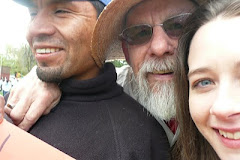
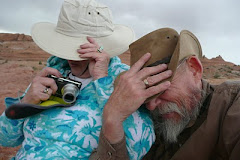
My guest picks up the other cup of coffee in his hands, as if warming them. Karen's coffee. He motions for me to pick up my cup. We're holding coffee in styrofoam cups. He puts his arm around me, and I put my arm aound him. We look at each other before the cameras. Han Shan I say, smiling, as the digital cameras take one more and then one more. I have nothing to give him and nothing else to say to try and bridge the gap that he has already bridged. I feel inadequate to the moment, even as I realize that I am only a prop. I remember I'm wearing my Panama hat that I bought at the market in Mérida. I take if off, and put it on his head. Finally, I'm communicating. OK, he says, aloud in the language we all understand. OK, OK, OK, he says, his voice celebrating the moment, calling again for the cameras. His friends, too, appear to be as pleased as he is, bringing forward their cameras as we pose before the story can be told later. Now we're taking pictures.
Han Shan, I say. Han Shan.
Jim Bodeen
18 de noviembre--24 November 2010
Cancún-Yakima
Getting off the boat, men ask, "Where are we?"
¿DONDE ESTAMOS?
Bish a tan
Matin a ta catan
U yu tan
Yucca tan
Jim Bodeen
16 de noviembre 2010
Bish a tan
Matin a ta catan
U yu tan
Yucca tan
Jim Bodeen
16 de noviembre 2010
THE MUNICIPALITY OF SOLIDARITY / -- LA MUNICIPALIDAD DE SOLIDARIDAD
LOS ESCRITORES JOVENES MARCHANDO EN LAS CALLES DE MÉRIDA
THE YOUNG WRITERS MARCHING IN THE STREETS OF MÉRIDA
They wear t-shirts with words--
Basta de hechos--Queremos palabras--
Enough of your good deeds and information--
We want words!
Queremos palabras.
And they spray-paint garbage cans
with words that make the gangstas appear
as children of an innocent world.
They are ascendant, though, not cherubs, as children of an innocent world.
asking tough questions with fresh mischievous smiles.
Their questions like Neruda's Book of Questions,
written surreally on columns of paper the size of trees unfolding
beneath the cathedral of sky.
God, they are beautiful! In their visions may they inhabit our bodies,
so we might be confused into growing diversely
in one grand imitation of their fresh word in the street.
Jim Bodeen
23 November 2010

●
TOCAYOS
Mi padre se llama Emmanuel
Dios con nosotros
Sí, Sí, Sí,
Dios con nosotros
Jim Bodeen
16 November 2010
●
Berries from shade grown trees
Warm salt sea floats back stroke
White bike wheeling light
●
Coconut buoys
Toes in coral sand
Waking with Karen
●
THE BUS TO MÉRIDA
On smallest keyboard
Karen types with her two thumbs
Haiku from Grandma
Jim Bodeen
13 November 2010
TYING THE DAILY KNOT
WHERE WE ARE TODAY
AN ANNIVERSARY POEM
42 years of marriage
15,340 days--
Add 1460 days of knowing
before the ceremony
16,880 days of knowing Karen
19 years old when we met
6,935 days BK
Before Karen
Some of those days have been recorded by others
I was not conscious
Jim Bodeen
23 November 2010
●
Poets leave campfire circles
knowing something else
is out there looking for them.
They must listen for this thing
that can't be seen. Not a time
for the queasy. Trust the voice
that says, "If you're going to be
funny, make me laugh."
Jim Bodeen
December 2010
THE DAY ETCHED IN SUNSHINE AND SAND
A WEDDING BLESSING FOR RANDI AND BRIAN JOHNSON
En la antigüedad, los mayas llamaban al matrimonio Kamnikte, que significa "el recibo de la flor." / In the old times the Mayans called marriage Kamnikte, which means "the receiving of the flower." La Bendicion maya
Corn exchange in the land of corn, golden,
filled with light and beauty. Two lovers in the light,
are light. In sunshine, they are sunshine,
and in sunshine they bring what they have become
in the long nurturing: corn's beauty.
The taxi stops at the market for fresh tortillas.
Corn and corn tortillas.
The people in the land of corn.
Giving corn to his bride he becomes the husband.
Giving corn tortillas to her husband she becomes the wife.
In the exchange of corn they become corn over time.
Corn becoming corn.
Each one seated before them at table
plays this out at the wedding meal,
bride and groom exchanging corn
in the becoming of the corn.
All watch husband and bride, participating in ancient ceremony.
All follow the corn to the eyes of husband and bride in the sun spell.
All hands at all tables follow the exchange of the corn
creating them in their becoming.
All gathered here becoming corn, golden, light-filled,
forms of beauty mirrored by this food come from the land,
arrived from this first harvest, ritual meal of the great beginning.
All gather in the Municipality of Solidarity, Quintana Roo.
Each one anointed, witness to many cycles circling.
Jim Bodeen
12-21 November 2010

THIS DAY FOR VONNIE AND CRAIG
Etched in sunshine and sand
For now,
For the remainder,
For all was and is
Jim Bodeen
12 November 2010
THE MAN WHO TEACHES LAUGHTER

EPITHALAMIUM
--for Kelli and Tyler
The wedding on the Mayan beach
brings together marriage and marriages.
News says it's dying out,
but you can't tell it by us
dressed in color
standing shoeless in sand.
Or those trying to get in.
This one marriage, minutes old.
Ours, 15,329 days.
The priest's question from 40 years ago:
When does marriage begin?
The Stage Manager asking,
Do I believe in it?
The marriage that isn't here--
more present than the ones that are.
That's not true either,
but that one standing before us
in its great absence, that shortest of marriages,
the one with the miracle birth,
that one, that's true, that's here.
Jim Bodeen
20 November 2010
THE MAN WHO TEACHES LAUGHTER
Laugh even when you don't feel it
is what he says. It sounded so stupid.
I went into the bathroom and cried.
Couldn't do it. No laughter from me.
When I told my wife
I laughed until tears came.
I felt so dumb. It felt so good.
Jim Bodeen
9 November 2010

BROKEN GLASS & WORDS ON WALLS

BROKEN GLASS--WITNESSING ERASURE
Glass in the alley, my alley
Back up and take a look
Too many broken beer bottles
Glass shards turn me around
Grafitti, Ramón, and Javier--not theirs mind you--
None of this work theirs--be clear on that
●
I'm in a gang but this isn't from a gang,
Ramón tells me. There's no sign.
They had a girl, Solita. See that?
Pointing. That garage door, there--signed.
See the Sureños?
I write songs.
You don't write songs with that bandage.
That's funny.
I'd like to see your songs. Do you write poems?
Some.
You want to write poems--songs, with me?
I want to paint that wall. That ain't right. It makes me mad.
Those guys had no right to do this.
Javier wants to paint this for you.
This is my community too, Javier says.
Javier--my neighbor--we have each other's back.
Backs of artists and writers.
What's up with this bandage?
I got hurt.
I see that. What happened?
I hit a wall. It hurts.
It looks like it.
I was mad.
Tell me about the anger.
I hit a wall.
It looks like it.
I put out my hand.
He give me his, still looking in my eyes.
My fingers feel the soft flesh
that never grew into fingers.
The guy was making fun of my burns.
Tell me about the burns.
I was six.
I was in this garage with another kid.
He poured gasoline and lit it.
I couldn't get out.
I had to run through fire.
I was on fire running through broken glass.
When I woke up I was in Harborview in Seattle.
I was there for months.
When I got out my Mom
had been sent back. No papers.
I was in foster then.
Yeah, I was born here.
Schools? Oh, I went to lots of them.
Seven, including Juvie.
We'll paint that wall. Javier says we'll paint that wall.
●
Multiple voices from my neighbors in the alley. Good kids in gangs. Gangs gone bad. Bad things. Bad things going on. But Javier. I can holler out to him in summertime from my bed. Turn it down a bit. OK, Jim, Always the accompanying apology. Politeness and manners. No estamos mal educado. Javier's place. The small rental beside our house. Alley entrance. I'm a recluse. Javier, the artist. Javier who put one poem on the Poetry Pole. Is that the original, I'd asked him. Always make a copy, keep the original, I'd said. giving him copies I'd made. "I belong to this community too." "I'm a recluse." "Jim, this is my P.O." "Jim, can we borrow some charcoal starter?" The one-way book exchange. Poems, Chicano literature. "What did you do with my poem? Do you still have my poem?" in crossings, saying good morning. Crossing. Passing.
This kind of relationship for two years. Always touching and skirting the real. The real right there, below the surface.
And now Ramón with this bandaged hand and the hand that never quite arrived in the world. Ramón with the burns and the seven schools in foster with mother gone writing songs--but not writing songs now. Ramón forgetting himself looking into my eyes and offering his hand the way it arrived from his mother's womb. Ramón who walks through fire.
Just a minute, I say, I'll be right back.
I'm not looking for a paint brush. Not yet.
●
Luis J. Rodríguez' poem, The Calling, is always close in Xeroxed copies. I can reach for it like I reach for my toothbrush in the morning.
The calling came to me
while I languished
in my room, while I
whittled away my youth
in jail cells
and damp barrio fields.
I carry the poem like I carry my wallet, close to my body, back pocket.
It brought me to life,
out of captivity,
in a street-scarred
and tattooed place
I called body.
Here it is again, laid out on a green plastic garbage dumpster in the alley I've known for 38 years in this neighborhood. Chest high dumpster, my kind of altar.
A few poems alongside The Calling, including a half-page from an unpublished manuscript by my friend Inés Hernández, her "Alchemy of Erasure." Somos tan invisibles que somos visibles. Parece que es un contradicción, pero no lo es. When a woman has to be made invisible, it is because she is powerful and her presence reverberates, touching everything in its path.
●
Shadowlands. Right here. Common neighborhood. The commons. Where I've been given a life.
My young neighbors. Naked honesty coupled with an equally fierce guardedness promising to look at things later. Ramón's hands that can neither hold a paint brush nor write songs. We'll get the paint. And they do.
Waiting.
Then it came.
The calling.
It brought me out of my room.
●
When we arrive. Cuano llegamos. We never arrive. We're always getting there.
Jim Bodeen
2 November--10 November 2010
Yakima
A Common Neighborhood
Subscribe to:
Posts (Atom)

 Posts