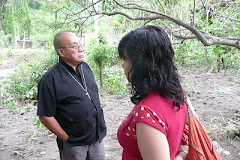
DEAN BRACKLEY, S.J., TALKING FOUR YEARS LATER
AT THE UNIVERSITY OF CENTRAL AMERICA, SAN SALVADOR,
AND HIS MENU—THE MONOLOGUE AFTER CLOSING TIME,
LISTENED INTO THE NOTEBOOK
Upstate New York. Here since 1990, I teach Theology, Moral Theology,
Systematic Theology. My menu: Where we are, what happened here, why.
Ellacuría and Company, forged this Technicolor Drama.
This university is a bastion of Liberation Theology.
200 theology majors—from Central America and Mexico.
Work on many rations. Dimensions Lou Dobbs and CNN
have no clue about. We're glad you came.
The more time you spend here, the more you don't know.
I sometimes feel like we're the new Puerto Rico.
We're economically polarized in an extreme way.
Generational polarization, too.
Part of an international diaspora. Salvadorans all over the world.
On islands off of Alaska.
How many poor people by U.S. standards?
The outgoing government said 34%.
The U.N. says, abusing statistics, 40%.
Criteria is two dollars a day.
I think 2/3 or more. My boss says 80%.
Twenty percent of working population has steady work.
Poor families have more children.
Half of them are extremely poor.
Young children—four to eleven months—60% anemic.
Thirty percent of children under five are undernourished.
This is stale data. Two years ago,
at the beginning of the price crisis,
grains and fuel pushed 10s of 1000s into poverty.
Investments, exports, imports, down.
Tax revenues, down. Social spending, abysmal.
I'm going to preach on the Beatitudes—Saturday, 5 pm.
Middle class? Some go to Pizza Hut.
Our professors in their clunky cars...
Eight new groups out of the old oligarchy—
finance, money laundering, tourism, commerce...
We have others, even weirder.
Drugs now, don't pass through the Caribbean,
they pass through Central America.
All this keeps people on edge, especially in the barrios.
The is the globalization of South Bronx.
The new economy installed itself.
No longer exploited, simply excluded.
Migration and gangs, options for the young,
got out of hand.
March 13, election night here, fantasy. Funes.
Twenty years...twenty years. Not 450 years.
First time oligarchy no longer controlled the state.
Mauricio Funes. This makes it permanent change.
A moment of no return.
Once people wake up it's very hard to put them to sleep again.
ARENA is crumbling. It's a honeymoon with FMLN.
But permanent change is happening. What will the Right do?
The FMLN is capable of political suicide.
We're extremely politicized, Patty.
Two Lutheran pastors killed. ID'd with FMLN.
FMLN emasculated center left Christian politicians.
Median population—50% are 23 years of age—or younger.
First generation raised on TV.
Girls aren't destined to do what their mothers did.
Girls believe they deserve education.
They all know about Hannah Montana.
Ninety-five per cent of population say
they have no doubt about God.
El Salvadorans can't get through a paragraph
without saying God.
Hillary was here for the Inauguration in a red dress.
Weeping, weeping, weeping.
If 95% of the people believe in God, Why?
The question is why we're indigenous here.
If it isn't good news for the poor, it isn't Gospel.
Los Martires, the minority, yes—
but they've had a majority impact.
Seventy-eight percent of Salvadorans say
Church should have the Option for the Poor.
Romero is a grant.
He's not invented by the Left.
As much as we can, feed the Gospel.
Romero emerges from a context....
He does not drop out of Heaven.
Two friends of mine—Ph.D.s—both removed.
Catholic Church now 55% of population.
Churches kept a barbaric silence during the war—
to undermine prophetic voices.
Now we have Pentacostal ministers reading Liberation Theology.
On immigration—we're down from 740 El Salvadorans
leaving every day. We estimate 400—500 a day.
Whatever happens, the majority of Salvadorans
will be living in the U.S. in 25 years.
We need a Marshall Plan. The U.S. owes us that.
You can tell that to Lou Dobbs.
It's not a pull. What is that big sucking sound?
They want to say, It's a push.
There ought to be a right to migrate—but there's not.
The end has to be sustainable development.
The [new] government has inherited an empty shell.
We have another war here.
All of this is going to happen, but you can't see any of it.
Solutions will come from the bottom up.
Churches are without peer...globalize solidarity.
Globalizing solidarity—you come here,
others come here—get their hearts broken,
and go back ruined for life.
Sheboygan through a ruined lens.
Like St. Ignatius said,
When you experience real joy,
God is the only solution.
Jim Bodeen
from the notebook
with the Habitat for Humanity Team from Yakima, Washington
29 October 2009—re-checked for accuracy, 5 June 2010
CASA DE SOLIDARIDAD
If one turns aside from Him
to go towards the truth,
one will not go far before
falling into His arms.
—Simone Weil, Spiritual Autobiography
The house that holds the people is a story.
Talking into the night a man forgets
himself for truth larger than the war from any side.
"I came here for the first time in 1980.
I had read about a meeting of bishops in Puebla.
They had met earlier in Medellín,—"
He's been telling the story for years,
following power and God and the poor.
People called him in his hotel room.
We know you're there.
His room, never on the street.
His bed against an inside wall.
Still, he felt safer during the war.
He speaks from his dreams,
from a jeep driving to San Vicente.
Some say he is more Salvadoran than Salvadorans.
He is not random, but after years of listening,
he's learned the damage of lies,
and lists them among bullets and earthquakes.
Simone Weil walks with him whereever he walks.
"One can never wrestle enough with God
if one does so out of pure regard for the truth.
Christ likes us to prefer truth to Him,
because before being Christ, He is truth."
Two small notebooks in his shirt pocket
record the week's observations.
He has found the lie but remains uncertain
of the truth that will replace it.
During the Romero march to remember,
he walks out of darkness to find his friend.
They talk briefly. He turns back to the street.
The story was here for so many years.
Everything from that volcano
remains in his shirt pocket.
—for Gene Palumbo
Jim Bodeen
28 March 2006
OH,
Those women
on those painted crosses
singing
with their arms
outstretched
their bodies
becoming crosses.
Jim Bodeen
June 6, 2005
WALKING INTO MUSIC
Walking into voices surrounding me in trees.
Each one a solo belonging in a choir.
Each one talking it out in song,
singing the same song on her own,
seemingly oblivious of all song,
of all sound but her own.
Las chicharras, solamente durante Semana Santa.
Nacen y mueran cantando, solamente las hembras—
Mujeres—chicharra la hembra—cantante.
Chiquirrín, el barón. ¿Qué hace?
Cicadas singing throughout the barrio.
Taking out language—or bringing it?
Nace bajo en sembra y muere como gusanita.
Only the female is born singing and dying in song.
Jim Bodeen
March 2006—June 2010
THE CARMELITE NUN WALKS ME FROM THE CHAPEL
AT DIVINA PROVIDENCIA WHERE ROMERO
WAS SLAIN DURING THE EUCHARIST
Everybody is walking to Heaven.
Monsigñor touched your heart.
Go and help him,
and he will help you.
We are all walking to Heaven.
Nice to meet you.
And we are going to Heaven.
We must start every morning.
It is necessary.
Jim Bodeen
March 20, 2006
QUESTION AND ANSWER MONOLOGUE WITH
DEAN BRACKLEY, S.J., PARISH PRIEST OF JAYAQUE,
WHO REPLACED IGNACIO "NACHO" MARTIN-BARO,
ONE OF THE SIX MURDERED JESUITS
AT THE CATHOLIC UNIVERSITY IN SAN SALVADOR,
THE DAY OF THE XXVI MEMORIAL MARCH
FOR OSCAR ROMERO:
This is my good friend Mary. She was here five years.
I've been here since 1990. You've been to Jardín Botánica?
That must be the way the country was—a paradise.
The new archbishop—very conservative—inflexible.
He's struggling with Romero.
Like the country itself, the Catholic Church is polarized.
So is the Baptist Church.
What do you do with the poor?
The poor are the crucified vicars of Christ
who set the agenda for the Church.
Now the war is...Gene Palumbo?
I subscribe to anything Gene Palumbo says.
He's in touch with reality. I'm in the university.
I spent the 80's in South Bronx.
Globalization of the South Bronx,
that's what's happening here.
I'm feeling more and more at home in San Salvador.
We've had crack for about nine years.
We have drugs and gangs and organized crime,
and maybe the Extreme Right's behind it.
If we can destroy people through drugs
they won't be protestors. What you saw
of my colonia driving by—that all filled with water
last year. There's no land to absorb the water
because they build these spectacular shopping centers.
Diez y Ocho—pandillas—cut their teeth
on Bloods and Crips. Hard line approach:
a crime belongs to a gang. You can be arrested
for having your head shaved and a tattoo.
It's unconstitutional, but...they have guns and grenades.
They show you their guns. They want to control their turf.
They change so quickly we can't keep up.
Local gangs have been subordinated by gang members
coming in.They'll come in and take over a house.
Climate of fear. This is not Cancun. Let's face it.
What are we doing here?
Main agenda in El Salvador: Come, fall in love,
get your hearts broken, and go back ruined for life.
And we're from the fix-it culture.
We're not going to fix this.
Sometimes fixing things is the distraction.
What happens inside us has the most lasting effect.
See the Bush Administration with new eyes.
Put your pilgrimage in context.
You're about the 18th group I've talked with this month.
And only a part of the people see me.
El Salvador has no purely local solutions.
Traditional politics isn't going to solve anything.
We're in a new time.
If we tried to have a voice—we'd be the Axis of Evil.
Saddam has saved Chávez in Venezuela.
Chávez is sitting on a sea of oil.
Bottom up, top down. Micro initiative
up against macro power. That's where you come in.
Alone, this country cannot pull itself up by the bootstraps.
Globalize the practice of love. Globalize solidarity.
That's the key mission.
We're discovering vocation—and good news—
no bishop can stop us.
Your part is humble—but you're part
of a growing movement. G-7 countries are aware
of your numbers. This is a sign of hope.
Fight the politics of intimidation and politics of fear.
What does Salvadoran reality tell you about the U.S.?
The median age is 19. Women wear jeans.
They say, Anywhere but here.
I do not want to spend my life in front of a comal.
They know more about Britney Spears than Romero.
On a slow day 700 people leave here for the North.
The U.S. deports about 100 people a day.
Within a generation and a half, a majority
of Salvadorans will be in the U.S.—
locked in unholy and uneven matrimony
in which divorce is not possible.
The news from Puerto Rico is in.
The most generous diaspora in the world
sends enough dollars to make up 1/6 of the economy.
Before they went to the guerillas.
Now they go to Houston.
Your question is my question.
Have you seen the U.S. Embassy? It's huge.
They now have tourism police.
Nationalize the government.
The government has been privatized.
The government will give you a cop to ride in your bus.
The government gives big tax breaks to its usual buddies.
What poor people don't want is trouble.
Mothers and servants vote for ARENA.
Voting for FMLN is dangerous because
it will bring the government's guns.
The Church doesn't want social problems.
They want to save souls.
Sacraments are important. Get them baptized.
You have been listening to the Minority Report.
Politics is crucial. You've got to denounce the crooks.
Cardinal Mahoney said last week,
If they pass this bill on immigration
I'm instructing my priests to commit civil disobedience.
You're important because the people believe they count
when you listen to their stories.
They think enough of us to come visit...
Jim Bodeen
March 26, 2006—Revisited for accuracy Memorial Day Weekend, 2010

Arriving at Our Age for Our People

STANDING BEFORE THE GALLERY OF PORTRAITS
For this day walks out from the bus
on a dusty trail, cloud cover making it possible
to photograph six faces giving up
an El Salvadoran landscape, and
understanding of what the poem might be
changes into revelatory storyboard.
Seared images in a collage of hats
and attitude, women in summer print dresses
harboring blue sombreros of courage
along with an exploration of memory
become a free will offering.
In exchange for this solitary walk
the pan flashing in rivers of sunlight
gives up flecks of what might be called
sustainability in a miner's lantern.
The canary sings! For this day,
all dust kicking up from heels
turns into new pairs of cotton socks
worn softly luxurious by school girls.
Howeveritmightturnouttobedaythisday,
six images, like the six poems
that will last that the poet prays for
in a mixture of false modesty and truth seeking,
this is enough—river beauty dreams
an emptied out parable
handing out treasure to passers by
some of whom are children's
children children in untold acts
of uninterpreted recognition.
Jim Bodeen
4 June 2010

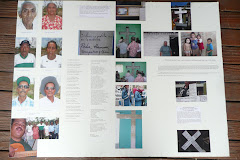
María Adelfa Villanueva, María Pérez Hernandez, Cruz Hermetario Hernández, Evarista Vallona Reyes, Francisco Jiménez Cesna: Seis ancianos de la comunidad.
JESUS OCCUPIES THE BOUNDARIES
That's the key in understanding
the alternative world, my friend says,
warming and warning my body.
That's quite a verb, occupies.
Whose Jesus? This notebook
cuts out on a morning bus
when access gets difficult.
A different world opens in a smaller book.
Last night ended listening to a man
talking about monitoring elections.
Vigilantes on both sides.
Guards, not outlaws, a false cognate.
But who knows which eyes witness truth?
Volunteers trying to see.
No middle ground. No middle class.
Company owners work employees on Sunday
so workers can't vote. Contrast that
with the love clap: once hard
with both hands. Kiss your fist,
circle the heart and open the arms.
During the election time
the person making Ignatius' Spiritual Exercises
contemplates the lip of Christ,
begging to love him more deeply
in order to follow him more closely.
Mornings, too, are marginal, Karen says.
Poems occupy the margins.
I'm certain of only this,
ready for what morning brings,
six elders be my guide.
Jim Bodeen
20 March 2006--3 June 2010
La cruz subversiva / Subversive Cross
PAISAJES DE LAS CARAS
LAS PÁGINAS DE LOS DICCIONARIOS CLAVE Y GUANACO
El terretorio que constituye una unidad cultural.
Estado independiente de su pueblo.
Papel, piel, tela que cubre.
Terreno visto desde un lugar.
Somos paisanos porque hemos nacido en el mismo pueblo.
Persona que vive en el campo.
La paisana vendía los productos de su huerta
sentada a la puerta de su casa.
Costumbres campesinas.
Palabra. Mi nombre es. Hablo con franqueza.
El nombre de la revista es.
Dar una persona su nombre a otra.
En el nombre de Dios.
Nombre de guerra.
La cara es cara de un luchador, y una luchadora.
Cara es luz en maíz.
Puro guanaco, también, lenguaje que surge
en oposición de represión y opresión.
Cucatlán, antes de la llegada de los hispanos...
el puro guanaco, el de la calle, un español mezclado con nahuatismos,
sugue usando una palabra para decir diferentes significados.
Es de tomar en cuenta que muchas palabras salvadoreñas
provienen de raices nahuat...
El cantón, la esquina de un edificio,
frijoles en situaciones complicadas,
vidaza, toda la vida,
la cara, paisaje de país, es mapa de la historia,
primavera eterna entre volcanes y terremotos...
Jim Bodeen
28 May 2010—4 June 2010

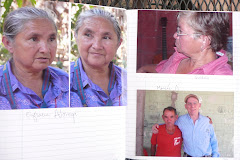
Rita Martinez, 75, Viuda de Avila

Cruz Hermetario Hernández, 70


Evarista Vallona Reyes, 81
 Francisco Jimenez Cessna, 79

HOMILY STANDING BENEATH THE CROSS
AT COMUNIDAD RUTILIO GRANDE
I come from the time of Romero.
I was formed in his time.
He was part of the Church
that denounced injustice.
We were slaves of the rich.
We were paid in the salary of hunger.
I am one of the combatientes.
In the name of God, don't kill your brothers and sisters.
No soldier has to obey the law of another man.
Only God can decide.
These were Romero's last words in his last sermon.
I was in San Miguel when it happened.
Write his words because he brings the word.
His story is accurate because it froze in his throat.
We were in shock. This is the story that is reality.
We live here seeding corns and beans,
We go into the hills to gather wood
to make pesos a day.
This is a developed community.
We have this Church.
We have a school.
I am the president of the parents.
I'm busy.
I have my beans and corn as well.
Rutilio Grande vive.
We were in Nicaragua.
Your country didn't want to let us in.
They said we were guerillas.
They stopped us.
We decided to make an activity to stop the cars.
We put sticks and stones in the street.
The police got us and put us in this dry hot place.
Engineers came.
We grabbed him by the neck
and called him a troublemaker.
They kept us thin
and then we started getting fat
because we weren't doing anything.
Then the plane came.
Jim Bodeen
taking testimony, translation, poem, portraits by Jim Bodeen
March 2006--Yakima, June, 2010
WALKING NOVEMBER EL SALVADOR/CAMINANDO NOVIEMBRE
EL SALVADOR 16 DE NOVIEMBRE, CON MEDARDO GÓMEZ
...es tan antigua como la vida misma, y tan nueva como el florecer continuo de la vida se produce cuando Dios se revela al mundo y nace la fe que reconoce a Dios como Señor y Salvador...toma actualided en cada tiempo o momento en que la vida pasa crisis y es amenazada porla muerte...declara la dependencia de Dios en los oprimidos, en su lucha por la liberación.
—La Teologia de la Vida, Medardo Gómez, Obispo, Iglesia Luterano
Surprises in the gift of the martirio
surprises me again this morning.
It's like this all day long, evanescent.
Bishop is both, like the others,
martyr and survivor. He will never die,
and lives walking the story forward.
The surprise comes from where the morning takes us.
Nobody's dying on these crosses.
Look at the flowers, look at the children,
look at the painted houses.
Jon Sobrino never was a sole survivor—
he woke in the morning as the next martyr—
the one who must keep on speaking
to tell the family story. Most recently, Los Carillos,
and their children wandering the Empire looking for work.
Imagine that. Do five minutes of research. Dolor. Sanctuary.
Ita. Dorothy. Maura, Juan. Rutilio Grande,
Oscar Romero, Seis Jesuitas, dos mujeres,
madre y hija—Elba y Celina Ramos.
Obdulio Lozano, husband and gardener.
Jon and Obdulio together now.
We're here to ask them what they need.
This is walking November in El Salvador.
Solidaridad es dar y recibir.
El evangelizador es evanelizado.
You have to lose yourself to find it, Jesus says.
Su capacidad de ser verdad buenas noticias.
Your capacity to be truly good news.
The branch gone. Cutoff and blocked.
Every piece of reality a confrontation.
●
A pastoral call discovered in crisis with opportunities
produced in crisis, personal crisis exclaiming,
Dios no existe—Dios es sordo y ciego—
working with people who have suffered contains hope—
Out of this, God says to Medardo in dark war time:
"You're my eyes, ears, mouth—my instruments.
You have to do this." For that reason,
it's theology of life, theology of liberation.
Teologia de la vida surge cuando la vida es amenezada.
When life is threatened, God-life surges.
Muy Luterano. Su lema principal es:
La atención por los más necesidados;
los pobres; los oprimidos; los explotados.
All of the children of God are in need.
My poor boss actually thinks the poor person is me.
Es una oposición y resistencia espiritual de los pobres
ante todo tipo de dominación, oppressión, y exploitación—
Teologia de la Vida—surge cuando la vida es amenezada.
Theology of Life—it thrives when life is threatened.
●
Obispo Medardo Gómez, practicality and testimonio.
El sentido del poeta. Caminando, caminando.
Y el pastor de Noruega—Sturla Stalsett:
Que nos cuentan las heridas y la vulnerabilidad.
Memories of wounds and vulnerability.
What does it mean to remember?—It’s ambiguous.
My memory is good—
and sorrowful. Es una memoria peligrosa—
una memoria que da...
continued disturbance inspiring hope.
Pecados del pueblo y pecados contra el pueblo.
Romero, Ellacuría, Sobrino—el pueblo crucificado
representa la presencia del Señor en la historia.
Forces that crucify the children of God.
What would the gospels be without the cross?
Mis heridas me cuentan algo distinto.
My wounds tell me something unique—and different.
Anyone can see God in beauty—
but to see the back side of God,
the suffering ones that one merits the name of theology.
This is a way of knowing something through the wounds.
Las heridas—que nos cuentan.
Las heridas nos hacen recordar.
Memorias nos enseñan tener respeto a los sufrimientos.
We can't love without vulnerability.
Even God cannot undo what has been done.
Walking with Medardo, and the pilgrim church of the poor
is an act of accompaniment. Didn't our hearts burn?
Walking together. Un caminar juntos y juntas.
Not a passive walk—walking together.
The 99 are not complete without the one.
Reconciliation of creation practices disvesting
our levels, nuestras niveles—a revolutionary act.
A community of one is a community of the other.
●
Yodo, respiro, agua, para el cuerpo.
Medardo in the morning with his telephone.
Hola, Hola, Hola, Hello. Hola, Hola, Hola. Soy Medardo.
Hola, Hola, Hola. A marching cadence.
Razor wire and gangs. Atentados. Maras. Pandillas.
Medardo driving into it all, delivering the day at breakfast.
Warmed, sweetened soy milk, torta de yema, and bread
from the Mexican Embassy, on The Day of the Dead,
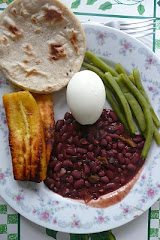
accompanying huevos revueltos and tortillas.
A chunk of cheese—queso de vaca—milk of the earth,
animales no sufren enfarto, y sus cuerpos producen Vitamina C—Medardo showing me all, content to see
what I can see and let it do its work when it's over—
and when is it over? When is that?
We're on a boat, the two of us among many,
hace ocho años—looking at pictures, and Medardo says,
Si quiere escribir poemas, venga al Salvador.
Come live with us and you'll write the best poems
of your life—clearly a contract with the devil—
Ah, Luz Bel—Medardo el Obispo, tells me later—
Somos disorganizados pero no somos tonto.
No sir. Get strong enough to move.
Echarse a perder, entonces arruniar.
Medardo never asked if I was good news.
He kept bringing it to me. La buena noticia.
¿Qué es esperanza? ¿Qué es profecía?
Subversive truth, like a subversive cross,
subverts the one who dares the confrontation.
Jim Bodeen
November, 2009—Walking the month of the Martyrs with Bishop MedardoGómez—
28 May 2010, Yakima, Memorial Day Weekend
The Patio

PARA
DON ALFONSO CARRANZA MARTIN, 88
—Mi copa está rebosando
Salmo 23
In straw hat and tuxedo shirt—camisa de esmoquin,
Don Alfonso dresses for the day. Black slacks and brown
leather belt. He's lost the cufflinks or never had them,
I don't know which, but his flair, su forma de hacer,
arrives in the cuffs, one hanging over his wrist,
one turned back to his elbow.
Don Alfonso Carranza Martin, 88,
en el campomento de los refugiados,
se llama Fe y Esperanza. Don Alfonso
quien perdió su dos hijos en la Guerra Civil,
me dió su mano y saludos, de su camisa
de esmoquin colgando sobre sus manos
sin butones o enlaces. He gives me his story.
—Me levanto a las 7:30.
Tomo café con pan.
Tengo 60 años de trabajar.
Nací en el cantón de San Sebastian.
Don Alfonso lost his two sons in the war.
I put photos of him on the inside cover pages
of my notebook and promise to deliver this poem.
You can see the cuffs dangling
one way or the other, flipflopping
like government officials. His daughterin the United States sent him this shirt
he wears everyday. Fe y Esperanza
is the name of the refugee camp
run by the Lutheran Church.
I ride in the pickup with Pastora Abelina Gómez.
I can hear her voice saying Don Alfonso's name
three thousand miles away. I have his portrait
with his leathery face to look at every morning.
Don Alfonso, so tall and skinny.
I hear of his death before I can return.
Don Alfonso wears a white tshirt underneath
his tuxedo shirt. Don Alfonso understands.
He smiles and nods. He answers every question.
Don Alfonso who lost his two sons in the Civil War.
Don Alfonso, remembered in the notebook—
voice, face, story, witness and style,
especialmente estilo—elegancia de personalidad.
Jim Bodeen
July 27, 2005—May 30, 2010

THE PRICE OF CONSCIENCE
A voice comes from the darkness
of the sky as I walk back to the house
after relieving myself. ¿Está en solidaridad
con la Guerra en Iraq?
Are you in solidarity
with the war in Iraq? A soft voice, unseen.
Antonio Ramírez, 60, calls from the scaffolding
on the other side of a wall below a palm tree.
The ex-guerilla combatant works with concrete
blocks before sunrise adding a room
to the house of Juan Carlos Perdonmo
in the repopulated community of Rutilio Grande.
No. Ojalá estoy un luchador por la paz.
Pero, es verdad que yo soy un soldado.
Estuve con los medicos en Viet Nam.
¿Por qué, me preguntaste de la guerra?
Quisiera saber más de la semilla de su pregunta.
Creo que su pregunta es parte de su testigo.
I believe that his question is part of his witness,
and that he comes forward to honor a larger story.
Antonio descends after permitting my camera.
He tells me he couldn't work for ten years
after the armed conflict in El Salvadro, tremors,
that a politician bought him these tools,
and he is the one on the hammock last night
when I arrived. He waited all night to ask his question.
Nuestros heridos son de la misma guerra, I say.
Our wounds come from the same war—I have tremors—
Paises diferente, pero la misma guerra.
With the notebook in the kitchen
while he sings: ¿Puede escribir las palabras
de su canción en mi cuaderno? He takes my pen
and says, We sang this song every day
during the war. It was one of our popular
songs of liberation: Se al soya nuestra roja
vandera abenser o a morir ya maya por la patria
y el mañana sosialista El Pueblo Armado vensera.
He sings the dream of the two little girls.
One daughter is bourgeoisie—burgesas.
One is campesina. He sings in the same quiet voice
that called to me from the scaffolding.
The campesina dreams of bread for her pueblo
to heal the dolor and sickness of her people.
She dreams of work, and better crops.
The rich girl dreams of being a princess.
The poor girl promises to become a guerrilla.
No cuesta para entender la gente.
Cuesta para llevar la conciencia. Having a conscience...
Jim Bodeen
March/April 2006—Memorial Day Weekend, 2010

LISTENING TO JON SOBRINO, WRITING IN MY NOTEBOOK,
WHILE LISTENING, AFTER RETURNING
FROM THE REPOPULATED COMMUNITY OF RUTILIO GRANDE
Birdsong at sunset
turns up the volume
as the solitary speaks—...reformulated for the poor?
Can you see the young man?
Un mundo salvado
Podemos hablar de esto.
The forgotten ones. Believers. Saved from below.
A world redeemed—We can talk about this.
To admire a man who repeats what needs to be repeated.
It couldn't be done
if it weren't for Jon Sobrino
and the few like him,
talking to power,
talking about power,
relentlessly talking, repeating themselves—
los pobres traen salvación—they mirror Christ.
Among us, the question is not
how to do theology 'after' Auschwitz,
but doing it 'in' Auschwitz,
that is, in the midst of a terrifying cross...
It would be so easy to bring flush toilets,
dentists, and doctors, to places like Rutilio Grande.
We need a critical mass.
Yesterday the world from above said, No.
The world from above doesn't have the humanity.
Flowers are important.
No sabemos sus nombres.
We don't know your name
en este mundo de abajo.
God of the life of victims
bringing us into a God different
than the God of thought
Saved from below
saved by your face
we don't even know your name.
The university can't save the world.
The poor teach hope. No one else can.
Y los pobres creen en Dios,
en algo tantos basico.
Participate in the risks
and change your life.
Jim Bodeen
23 March 2006, University of Central America,
19 April 2006, Yakima
28 May 2010
[This poem is a compilation of notes, of visual and aural observations taken in an altered state during some of the time periods listed. Notes are internal and external without citation. Italicized lines, did, but no longer come solely from Sobrino's book, Jesus the Liberator: A Historical-Theological View. jb]
AN EXTRA SET OF EYES:
CONTRADICTION OF THE FROG AND THE POET
—para Alfonso Kijadurías
Contradicción y coherencia : Sapo y Poeta / Frog and Poet
La poesía siempre ha sido el poder y la renovación que desplaza los limites. El amor es su patria, la insumisión su ley, y su lugar está siempre en la anticipación.
—Alfonso Kijadurías, ganador de Premio Nacional de Cultura
[entrevista con Alfonso Kijadurías en el Diario suplemente cultural tres mil #10267 de noviembre 2009]
It's an odd thing to walk with power
when power walks with the poem.
Of a sudden, a newspaper is placed in my hands.
The hands who place them there, says,
Tengo el sentido del poeta.
The poet says, Poetry has always had the power to displace the limits.
Poetry as motherland and fatherland, following poetry's law,
anticipating the world made new.
The government gives the poet a prize
and the poet gives the government a poem about a frog.
The poet discovers a frog hidden in the rocks,
one eye open, one eye closed.
The poet knows that the frog is God.
This is as much a problem for God
as it is for the poet because, fundamentally,
the poet does not want to listen to God.
He'll think he understands
when he doesn't understand a thing.
There you go. Given the power,
the poet knows the laws he's responsible for,
he knows to whom he bows and begs.
Even knowing this, looking at the frog,
he can't quite keep a straight face.
One more thing. What about the power
that put the newspaper in the poet's hands,
hands themselves representing God on earth?
Jim Bodeen
23 May 2010
IN THE KITCHEN
How it happens, happens in its own way.
It has something to do with disinterested search.
My friend brings out an old cassette tape
she's been carrying for twenty years.
She's on a dirt floor in a rain storm in Central America.
The priest says rain relieves daily stress and helps one forget the war.
Above or below, it may not even matter.
It became clear to me I never belonged to anything
from above. I knew
I was the poorest of the poor.
Neediest of the needy.
Believe me, I scoured landscapes.
God surrounded me with expensive knives
and gave me my own poverty—some kind
of joke between the two of us,
and he gave me the ones who would let me do my work.
Jim Bodeen
22 May 2010

OSMÍN PACHECO AND THE PATIO
Union people, that's who we are.
Este es el cantón de San Antonio.
Somos unionistas, Osmín Pacheco says.
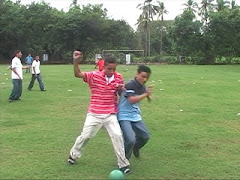
We stand in the middle of the soccer game.
Young people playing through us
shouting for the pelota, kicking the wet ball.
In a downpour from the tail of Hurricane Ida.
Teenagers, girls and boys, at joy speed,
hair streaming water, a young woman
in a breakaway.
Esta cancha de fútbol
aquí, era el patio de la hacienda.
¿Qué dice? I ask in disbelief.
This football field, here—
the patio of the hacienda?
Osmín points to the four corners marked by flags.
This soccer field was the patio for the casa grande.
Osmín shows me where helicopters landed.
Rutilio Grande belongs to this community.
He smiles. Sí, sí, sí. Los jovenes nunca jugaron aquí.
The children run through us laughing.
Jim Bodeen
13 noviembre 2009—Cantón de San Antonio—
24 May, 2010, Yakima

Subscribe to:
Posts (Atom)

 Posts
Posts