Tree Island Sky Clearing North in the Mothership
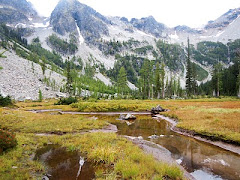
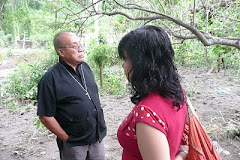
Traveling North from Victoria, B.C. on Vancouver Island, the Mothership encounters salmon spawning at Goldstream and Mountain Hemlock at Campbell River.
Storypath/Cuentocamino. The practice.:
THIS IS US
Carrying all this music.
We didn’t see these fish
coming up river.
Ride the spine
of the island north.
Rumors of stones emerging
the only story.
The eye doctor
has a new camera.
Those nasty floaters
can be seen. Keep an eye out.
The tree man picks up his phone,
the mothership turns around.
The woman walks up to me,
her hands full of shells
from the beach. I hold her hands
red from cold weather.
How to read this book?
The old coffee percolator
resurrects language becoming itself.
Who to talk with
is a brewer’s question.
The tree gets its bark
on its 100th birthday
staying warm under
thirty feet of snow.
These rough cuts
accompany the woman
sitting beside me.
We are the lucky ones
bringing trees across the border
with papers.
Jim Bodeen
20 November 2014
Star Dust On My Fingertips: Letter to Cynthia Moe-Lobeda
STAR DUST ON MY FINGERTIPS: LETTER TO CYNTHIA MOE-LOBEDA
ON EVIL, LOVE, COMPLICITY, ETHICS, JUSTICE &
NEIGHBORS
—for my
brother, Chuck, and his wife, Lena Bodeen
“We, as every other thing, living and nonliving, are
offspring of the same parent that flared forth some 13.7 billion years ago in
the cosmic event known as the ‘big bang.’”
—Cynthia
Moe-Lobeda, Resisting Structural Evil: Love as Ecological Economic Vocation
1. The
Ministering Women
A little gold dust falls on us all.
This is the medicine of the women.
This is the medicine of the ministering women.
The medicine belongs to the vision quest of Crazy Horse
and the disappearance of his medicine bag.
The women are caring for one of their own.
They have taken on the cancer.
Ministers and distant cousins of the stars, sisters to
all,
they know what it is, the cancer.
This is their medicine.
They do not ask how it all turns out.
This, too, is their medicine, their practice.
They ask for no guarantees.
Who will accompany me to the river root
where rivers coalesce,
where fabric takes on texture,
where the singular disappears
in collective beginnings.
Medicine and the earth.
To whom does the earth turn for justice?
She is my sister, too, the dying woman.
This bowl of soup.
This inclusive medicine of the ministering women.
This single portion.
Help the man to the counter, to the stool.
Point to the spoon.
In the emergency room, family gathers around the bed.
This is the portion of the witness.
One of the gathered leaves the huddled talk
and goes to the dying woman,
and whispers, I love you.
The woman whispers back,
I love you, too.
This is the voice in the medicine bag,
confirmation and validation.
This is the understanding witness.
Hearing is the last sense to abandon the dying.
2. Healing and Resisting— Moe-Lobeda Books as
Bookends
Bookending a decade.
Globalization and God. Love as Ecological-Economic
Vocation.
Holding up your new book in the basement room,
the immigrant woman points, hand over her mouth,
and my wife exclaims, Kristen Gilje, the tree woman
on the cross from Holden Village. The painting hanging
in the isolated North Cascade Mountains blesses your
words,
makes you an intimate with the women. Subversives
dressed in art to wear. Ben Shahn’s Red Stairway
goes up and down, in and out of Hell
while women carry water in clay pots in cycles of
invisibility.
To abstract is to draw out the essence of a matter.
Separate fundamentals from irrelevant material.
The mayor says, Water for all.
The women say, Show us the faucets.
Democracy disabled. Be. Know. Do.
What happens when transnational corporations
are more powerful than your government.
The poem is the place where people may speak the
unspeakable.
You’re so good with Luther in the broken world.
Christ may be received only after the person
has utterly despaired of ability to justify self.
I’d forgotten your work with Luther and sin—
se incurvatus in se—self
turned in upon self—
talk about rusty tools! So sweet to read,
such heat from hot rocks. I carried you
in the blue book back to El Salvador,
carrying too, rural North Dakota roots,
invisible, still connected to the power source.
Hegemony is more Minnesota than North Dakota
as far as language goes, how one talks over coffee,
but we know what you’re talking about
when evils starts dressing up to look good.
I’d have to say, I’m part of that one.
Complicit? I love that part where you quote
Aida Hurtado and the good guys
having the gift of infinite goodness
because they never have to be personally bad.
That image of you at fourteen in Luther League
watching sugar cane workers in the Dominican Republic,
the best. If there’s a thread of greater vision
than America’s young, aghast, horrified,
watching a film, I’ve not seen it.
Sustaining, sustainable.
Here’s one back. A fourteen year-old girl
in our town, takes her laptop computer,
calls Alan Storey in Capetown,
brings him to Yakima two months later.
We have this room in the church basement.
We talk some. A listening place.
I’ve been talking about you for ten years.
The fourteen year-old’s mother says,
Cynthia is coming to Yakima.
Advance invitation, I guess, or warning.
3.
Q&A, Prójimo, Grammar: The Loving Resistors
The young man sits opposite me
writing in his notebook, as I am writing in mine.
Maybe he’s in his 20s, here with questions,
as you wind up your mud-song, earth-chant, economic love vocation,
a program with urgency ,
when his question arrives,
which you ask him to repeat.
What is
repentance?
Bless
your heart, you say, Bless your heart
for that beautiful question. Hold on.
If you’re not suffering it’s difficult to see.
It operates regardless—even when only the good are
involved.
This is structural evil.
Love makers—Our God is at play in the world. Making love.
There are 25 million climate refugees in the world.
What does it mean for the people here gathered?
Heeding our call to love requires high stakes.
Step with me in courage.
Through climate change we are doing un-creating.
We are a dangerous species.
Resistance is one of the doorways to moral power.
Failure to repent is our failure to see.
Repentance is the other doorway.
[At this point the question arrives.]
What is
repentance?
Beautiful, beautiful question.
A reduced understanding of sin means a truncated vision
of salvation.
It’s ability to hide confirms its wickedness.
Repentance calls for fields of literacy in that sin.
Lifestyle changes in housing and eating and travel.
Responsible buying and investing.
Alternative sources for news.
Whose vision of the world is to be told?
These are some of the tools of the unraveling.
None of us is primarily an I.
We are, in fact, first, we.
Thank all of those who enable you to be here now.
All of those living inside your tear ducts.
We are a cloud of witnesses,
wide-spread, burgeoning.
A movement.
These, your forms of action, loving resistors.
Thirty years ago I sat with a young man on my porch.
Usted es mi prójimo, he said.
Mi prójimo.
Para nosotros, para los mexicanos no hay palabra más
grande,
más fuerte, más importante. Prójimo.
His description and eloquence,
the openness and depth of his heart
made it too large for me to see.
I was his teacher at the time.
A young man, too.
He was a wrestler, a luchador,
another word he taught me to see and to know.
He would teach me about the asparagus fields.
Already a teacher cutting asparagus.
He put the asparagus knife in my hand.
He would exceed his own dreams
stepping out of strawberry fields
into multiple worlds of many languages.
But that day he walked me next door,
and knocked. When my neighbor came to the door,
he said, Aquí, Él es su prójimo.
Here is your neighbor.
The beautiful question stands before two doorways.
Cynthia Moe-Lobeda will say all is neighbor, including
otherkind.
Sort that one out for yourself.
One can’t know what the young man heard.
What went into his notebook.
Because the question is mine, too,
I don’t get it all.
The surprise seeds itself—into the indicative,
away from the imperative. No world of shoulds
in the mouth of Jesus.
You write in the coffee shop,
one of the ministering women.
You shall love your neighbor as yourself. Agapao.
Finishing like this:
You have the power. You’re not being told to.
Already part of your divinity.
Jim Bodeen
25 September—21 October 2014
Pacific Lutheran University/Yakima, WA
GOBI-RATTLER ROOM CORRESPONDENCE
LETTER TO SEFERIS IN THE GOBI-RATTLER ROOM
“I
do not say loveable or admirable.
I say sympathetic, sentimental, mediocre,
wasted….He symbolized those to whom
we refer in daily conversation
with the
expression, ‘the poor devil.’
However let us not forget that these guileless
men, exactly because they are ‘easy’,
are often the best carriers of an evil
which has its source elsewhere.”
--George Seferis on Elpenor.
[Elpenor, drunk from wine, fell from roof and broke his neck. Young and foolish, first among the dead, and first one Odysseus sees in Hades.]
This is a room in a house nobody knows,
so how could they take it? This afternoon
I must return your books to libraries
where they’ve found homes; California
and Oregon, inter-library loans.
Your diaries quicken my heart; Lines
from your poems fill my notebooks.
The first
thing God made, the long journey.
Memory hurts wherever you touch it.
Like that, over and over. Front to back,
and then back to front. So many guides
Edmund Keeley and Philip Sherrard,
lovely Anvil edition. A Poet’s Journal:
1945-51, Athan Anagnostopoulos,
my favorite, and over time
Sam Hamill opens doors three decades past.
So I come to know
Stratis Thalassinos,
How can
you walk with the dead?
Flowers are in heaven,
Chris Smart says.
And you? We are the seed that dies.
And I entered my empty house. Now?
Blessed be your inability to
see.
Exiled arms witness
against torpor
in tattooed
words. Your Banquet Speech
for the Nobel, Poetry has its roots
in human breath – and what would we be
if our breath were diminished?
You speak for the sailor in
our souls,
unearthing us, scouring
words new.
Poetry is an act of confidence,
and who knows,..our unease
…not due to a lack of confidence?
Images in ocean waves clear
out
careerist collars clinging
neck-tight,
false calls secure in
abstract dis-belief.
You’ll get used to it, little by little.
Coming home. They don’t live
in the poem.
What Neruda called La
muerte pequeña.
The little death. Both of
you, Mr. Seferis,
humble at the banquet table,
Neruda,
most local of local poets, You:
We are lost because we have been unjust.
I was in high school when
you spoke.
50 years later,
building home in a poem,
I type your words and pin
them to a wall
made of words. Fated archers, diplomats
miss target after target. In
my time
TV sport never ends.
Elpenor cheering.
Forgettable whistles furthering holocaust.
You stand with Rex Warner in
the stadium,
understanding. Coded language of love
before the horror. Steadfast
in sympathy
for Elpenor, who we can no
longer name.
My poor, foolish Elpenor. Oh, Help us!
You instruct in diary and
anecdote,
one day going for a swim,
coming on
the sunken wreck. Surrounded
in water and light, the
poem, Thrush,
born here—close the curtains
to bring what’s been hidden
to the surface.
Jim Bodeen
1 September-15 October 2014
This Ineffable Thing

THE UNDERTAKER AND MY BROTHER GRAVESIDE
So this is my work, undertaker.
Walking with you and my brother,
delivering the spirit body,
soul house, from the land of illusion
to the otherness in the air.
The otherness in soil,
body in a treasure box,
my granddaughter’s language.
Williams said it first,
I will teach you my people,
and I’ve only done it once, well,
only once,
when Mom died, that time.
You were both present,
with work to do yourselves.
So this is my work, too.
Talking like this. This airy talk.
The undertaker, the one
who rides with the bodies,
who rides with the bodies,
is my friend. He says to me,
It’s getting harder and harder.
We talk about the grave diggers
in Hamlet. Try and give him
some encouragement. Hold on now.
My son-in-law remembers
My son-in-law remembers
the man in Moxee used to dig graves,
called him Digger. Grandchildren
climb the Japanese Cherry by the grave
where my sister-in-law’s casket rests.
Hamlet’s been gone. Doesn’t
know his girlfriend
drowned herself in the pond.
Comes in the back way,
finds himself listening to the two digging,
finds himself catching up, stunned
by their irreverence
which in many ways matches his own,
and then the procession comes,
court ceremony and all, Queen Mother
on the King’s arm,
his girl friend’s brother, Laertes,
the one he’s been fighting with,
everybody grieving, his world
collapsing before his eyes.
I’m getting into it, but my friend,
working the ceremony,
gets distracted. And my brother,
with his grief in his hands.
Did you know Our Town?
I say to the undertaker, when he returns.
I’ll get it for you,
we’ll read it together. I’ll order copies,
one for him, one for my brother
whose wife’s body is in the casket
beneath the Japanese Cherry
where the children climb, and the third one
for me, in case they ask me
to sit with them,
to sit with them,
reading graveside. The undertaker’s been
the stage manager most of his adult life,
but never got to read his own lines.
My brother can sit here in Act III
and hear Emily say to Simon Stimson,
Live people don’t understand, do they?
Maybe the three of us
can drive to Anacortes,
sit on the bench by Ray Carver’s grave
and read together, weeping and laughing.
I’d like that. People with other lives
than in books get cheated this way,
living in the commerce of things,
even in my brother’s case, a baseball game.
The baseball coach and the undertaker
with this play at Ray Carver’s grave.
What we talk about when we talk about love.
What we don’t talk about, you know?
My loneliness comes from those books.
I know that. I’m trying to learn
to be quiet for my wife’s sake.
Once more talking to myself.
A husband’s 50-year grief talk.
But the undertaker, and my brother.
What might connect them
more fully to themselves is my life. What
establishes my solitude is my work.
I’m reading George Seferis’
Journal from 1945-51. The librarian found
it for me in an Oregon Library. June, 1946,
he writes, The mountains,
each inside the other,
are bodies hugging each other, flowing
into each other; they complete you.
Someone has taken a number #2 pencil
with a sharp point and made a small dot
in the margin crossing time and distance.
On the next page, where Seferis wrote,
But to say what you want to say
you must create another language
and nourish it for years
you must create another language
and nourish it for years
with what you have loved,
with what you have lost,
with what you have lost,
with what you will never find again.
And the same dot
with the same sharp pencil.
with the same sharp pencil.
This goes on and I begin
writing the passages in my notebook,
The days are
stones.
Realizing slowly,
The pencil marks are mine,
from decades ago. Same book,
same library, the exile
still trying to find his way home.
I recall the poet who led me to Seferis,
the many things I learned from him.
I recall ordering this book before.
The way of being a poet.
And this same book.
Long apprenticeship and ancient way.
What can and cannot be said. This same,
worn and lovely book, warm in my hands.
Seferis himself, reading again,
The Odyssey from the beginning.
This ineffable thing—
words barely
scratch its surface.
These beautiful children
climbing this one tree.
The chance of us all being here.
The poet saying, Just
being here.
The falling.
The falling is about to begin.
My brother and the undertaker.
The falling.
The falling is about to begin.
My brother and the undertaker.
The Stage Manager asking
himself about marriage.
himself about marriage.
Hamlet returning to Elsinore
through the back gate.
All gates open.
Jim Bodeen
8 October 2014
Jim Bodeen
8 October 2014

Ways You Try And Reach Me, Lord
WAYS YOU TRY AND REACH ME, LORD
I've been stepping in dog shit all morning.
I do not name the dog.
Jim Bodeen
5 October 2014
GOSPEL FOR LENA
LINER NOTES FOR THE COMPILATION OF SONGS,
GOSPEL FOR
LENA,
SONGS
FOR MY SISTER-IN-LAW’S CROSSING
Dear Chuck, sweet brother.
These songs,the only thing I know.
Lena and I talked music,
she liked jazz, here’s my list
with no Miles. Lena liked Miles.
Be sure, his back is turned,
and Lena’s smiling. How these songs
got here, what I want you to listen for.
Gretchen wanted Amazing Grace.
I get to pick the recording.
Charles Lloyd has a 2-hour set
for his mother crossing,
Lift Every Voice and Sing. Gretchen
will track her mother to paradise
if she finds all of it,
and gives six months
to nothing but You’re So Beautiful.
Not here. What is here? Lena’s listening.
Listen, when your girls finished
writing the obituary
we took out every reference
to here,
as in not here, substituting
earth for here, believing, in
fact,
Lena’s presence. What a privilege
being in the room with your
daughters,
fully adult, as they wrote,
Megan saying at one point,
This seems like Dad’s paragraph—
the one detailing how Lena
the one detailing how Lena
kept football pools quarter
by quarter
with prizes to keep up her
own interest.
Dad’s paragraph, his call.
They wrote Glioblastoma out of our world.
Chuck, sweet brother, Coach
of Our Valley,
good husband, best Dad, and
Papa,
I’m getting warmed up,
under
the influence
of Megan and the way she
led
the gospel songfest
around Lena’s bedside.
Cottage in the Meadow-hospice,
blessed place for
family.
When Megan and Julia led us
singing Blessed Assurance,
everyone in the room became
believers.
Iris DeMent learned
the song
from her mother,
who believed like Megan.
Like you.
Iris DeMent comes from deep
river country.
She sings from, and crossing, riverbanks
most of us have never seen.
She’s here, twice.
Just because, just because.
And for Megan.
Chuck, these lines aren’t testimony,
but a kind of code. When you
hear
Archie Shepp’s clarinet
on My Lord, What a
Mornin’
picture Julia taking out her
violin,
playing for Nana’s crossing.
Note, too,
there are two versions
of What
A Morning.
These, the most
beautiful
ever recorded. Charlie Haden,
Hank Jones,
Archie Shepp, Horace Parlan.
Hank Jones had this bone
disease capable
of shattering the bones in
both hands
simply by laying them on
piano keys.
And Elvis? Aren’t we
Justified
by our listening? I’m just
about done,
but Marsalis and Clapton
carry on
with Just A Closer Walk with
Thee
for over 12 minutes. It’s
here
for that drum solo. Those
are kids
banging on pails and garbage
lids.
They’re at the ball park
watching you coach
during the closest of games.
You’re on third base, working
praise songs,
coaching Lena on the Bridge
to Heaven.
You’re really coaching.
As
you said, I was.
There was never any doubt in
the outcome.
Thanks for that walk, for
permitting us
to be present, to be
in the
room with you and Lena.
The rest is easy. Gretchen
reminded me
of Mavis Staples, how we
listened
one day on our way up the mountain.
42 years of marriage.
Jackie
Robinson’s number. 42 years.
40 Days in the
Wilderness. 16 Songs.
Chuck, I’ve always had to go
through the City of No,
to
get to the Paradise in Yes.
Leonard Cohen sings through
fire,
he’s King David creating
the
Psalter of Our Days.
The women in our lives,
Karen
and Lena,
like Ruth in the corn.
Wherever thou goest, turning tables on us.
Where they go, we go too.
Love,
Your brother,
Jim
22 August—1 October, 2014
Subscribe to:
Posts (Atom)

 Posts