EARLY SATURDAY MORNING, RIVER TIME


        Suiseki Stone by Bob Carlson


EACH SPOKED WHEEL TURNING IN SILENT BEAUTY

That is the seclusion of sunrise
Before it shines on any house.
—Wallace Stevens,


Because he was making way, bringing way,
the voice comes from the river carrying water
along with river stone. Water stone itself
in recognition of its rule: it’s not enough to like a stone.

Add the horticulturist from the university
subjecting trees to everything trees encounter
in nature, amplified: wind, drought, deluge,
to find principles involving development

of the lead branch. Crossing time
in jet planes, young Americans apprentice
themselves to the sensei teaching them
to wash out cups and cut roots, surviving empire.


·          

Reality is spirit’s center, the poet says.
Every poem is a poem within a poem.
Into this matrix, I enter the room,
a man too old to enter a monastery,

holding a tiny tree in a shallow tray.
beginning again.
The young teacher says, Sensei
pointed at the tree. I didn’t speak Japanese,

he didn’t speak English. He pointed
at a branch, and touching it,
holding it flat, straight out,
exclaiming, Pffft—wire it like that,

while turning his arms into tree limbs,
straight, at right angles to the trunk.
Pffft, I said, nodding in recognition
to my teacher, turned into a tree,

my arms as branches angled
at 90 degrees. Mr. Kamamura
looked at my tree, branches like this,
Pffft. Turning away in disgust,

he told his assistant, The worst
wiring of any tree in the garden.
That’s how I learned to wire
branches with movement.

·          

I hold the scissors in my left hand.
Forty years ago a Ficus tree
died on the kitchen table before me.
Two years ago I entered this room

with a small bush, Pyracantha,
cutting the roots, wiring it
to a shallow pot, past lives
before me a running narrative—

a half-century with Karen,
seven decades spent
surrounding myself with the poem.
Each thing returning to its root.

·          

Look at all of the fronts of your tree.
Which ones are the most interesting?
The black pine loves sun and heat.
It gives up strength for its lovely bark.

Don’t cut too many roots
and no excessive bending.
Let’s do a quick one-minute sketch.
OK, I know what your idea is,

I’m trying to follow your narrative
into this branch. What does
Wabi Sabi mean to you?
To me it’s time passing, shortness

of life. It’s a subdued all, low key.
We want the tree to come towards us.
To lean towards us, as in embracing.
Take out what absolutely can’t be used.

Yes. Cleaner. Increasingly sparse.
A little older. We’ll put some wire on
these guys so we can see
what’s going on inside. These

are the tools of length and space.
This branch helps this branch grow.
They all help each other.
A bonsai spends most of its life

being wired. The cost of beauty?
The freedom in discipline?
Shallow and long containers add height.
Shallow pots need to be wide.

Like a rubber band.
Deeper pots need to be wide.
Nitrogen for what’s green.
Potassium for roots.

Nobody actually knows how moisture moves
through trees. Only theories.
Especially with redwoods.
Monterrey Pines are totally fog dependent

with weak roots. As focused
as we are on the apex, we forget
how important it is to set that first branch.
The apex. It’s gone as far as it can go.

The tree exhausts itself to get here.

·          

Handing me keys to our first house
45 years ago, the banker says,
This is a good starter house.

There are many words
for beginners, most of them disparaging,
all of them current, common in usage.

We knew something about humble roots,
setting out to make a house.
The house, the stone, and the tree.

Three children. And we had three children.
The Black Pine stands before me as my life
I will leave without seeing a finish.

Each of the words for beginner
belonging to me. How many stones
have I carried from the river to the garden.

The integrity in stones come from the stars.
I hold a mountain range in my two hands.
The stone is a six-sided temple.

·          

Just as it was literature that brought me here,
it is literature asking the question of inheritance.
Three children, each of them beloved.
Literature is the house where we live.
A house, a stone, and a tree.
The two thousand year old Sequioia
stands, green peace grand.
The stone shows us the gold dust
from a dark star in our fingers.

This is the treasure for the children.
House, stone, and tree.
A portion for each.

Jim Bodeen
7 September—5 October 2013


EARLY SATURDAY MORNING IN OCTOBER

The man who slips in water
wearing his rubber boots
finds out how long it takes
to fill the boot with water.
The imagination can work
with the fact of a wet sock
in a boot. The fire beside me
does not come from the fire place
or a campfire. Yet I am warmed
by Stevens as I put Kierkegaard
by my elbow. The poet says,
God and the imaginer is one.
I suppose the imaginer is God.
Poetry hands me the books
to see what might happen.
Switching languages every so often
because they’re here with coffee.
The left hander can put the hearing aid
in his right ear, but he always turns
the speaker for the left ear
to the world. He can’t do it
any other way. It’s part
of the deal he was given.
The lines are as real as the allergies
causing the old dog to scratch,
scraping away all of her fur.

Jim Bodeen
5 October 2013

Water Falls Straight Down


THIS IS THE PART OF HERE
THAT SAYS WE’RE ALL GOING IN THE SAME DIRECTION:
A FOUND POEM IN KAREN’S NOTEBOOK

Brown and black, this is a winter-time stone
coming out of the water, coming out of the clouds.
Until it finds its way to go
we need to look at it lots.

Color and shape, rather than absolute
reference place. Clean it up,
because the color is so much of what it is.
Enjoy it and find a story to match.

Push yourself to look for something else.
Rain works so well, because it has so far to fall.
Take the stone. Go from end to end.
See what rises up.

Buddha goes into a rock
to get out of the hypnotic rain
and is delivered into enlightenment.
This stone is just too wild.
It’s like the ocean itself.

There’s the human and the nonhuman.
We’re looking for an edge
that’s right between those worlds.
Gravity takes water straight down.

Jim Bodeen

3 October 2013


YET ANOTHER TRIBUTE TO THE PAST

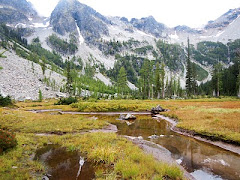
Water after rain on White River
ran high over the one-man log bridge
and we couldn’t cross. My granddaughter,
disappointed, slept with her one-sided vision,
asking in the morning if the water
might have gone down.
It was the bridge gone,
and water running high
as we walked up river over stones
wrapping us in storm’s aftermath.
We carried our lunch in backpacks
until we found shelter among boulders
large enough to protect us from wind.
Both of us knew the storm’s terror,
and I envied her courage.
Storm had called on her early
to walk through danger.
What I folded into my sandwich
beside the river emerging
from the snout of the mountain’s glacier
comes up this morning from music
after a night-long confrontation
with grace, anger fully present,
holding back its bile.

Jim Bodeen
1 October 2013


We Have Rocks Like That In Our River


STONES IN THE NACHES RIVER

Restlessness of the eternal
won’t be found in these stones.
This is the way to Nina Simone’s soul,
native in ancient waters. Move
with what’s pure and quiet.
Whitman says the days are gods.

All you can count on with your fingers
is here. While folding this morning
into riverbed, the prayer
for unseen practice turns over
with a stone. Here is the word
in bread. It’s all a swim in the pool,
a rock in river time. Stories
all give up their color
in river sounds, and what's far
in my friend’s poems
circle in the eddy.
We’re gleaning now,
entering what's dark and wet
anyway we can,
our daily way
and prayer for practice.

Jim Bodeen
30 September 2013


A DAY ON THE NACHES WITH KAREN IN THE RAIN

All the rocks rise up
from the river
dressed in rain

If they weren’t greeting us
they were putting new color
into Karen’s scarf

Jim Bodeen

27 September 2013


Carrying the Notebook into the River

BECAUSE HE WAS BRINGING WAY,
VOICE COMES FROM RIVER WITH STONE

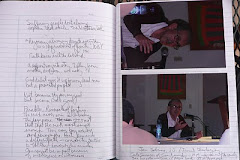
Fragments of notes from the Suiseki notebook,
Voice of Bob Carlson taking us into Spokane River
Listening from the side, walking in water
Different ways of doing this, too
One small area or water
Pick them up Turn them over Put them back

Eel River is classic, three tributaries

Hard minerals, looking for anything that will take a polish

Plum blossoms, geisha girls—We’re not looking for pictures of things

Color is what this part of the world is all about

Near, far mountain stones, like the title of a poem

Six-sided art form, really a way


If the stone is chipped
you have to leave it
or your Magic Mind
will heal it in the river

This is pretty classic material from around here, I’d think

You have to collect what’s here

Patina comes through water and rain
River develops this patina
Go out and rub it once in a while
Patina will develop
Leave them, rub them. Don’t fuss with them

Daiza. Its seat or throne

Sides go in all directions
Front and back
Look for six sides

Maseki is the masterpiece
                                       
When it rains, scrub it out
Do ha is a plateau

Try to find stones that don’t have a lot of breaks
It limits what can happen

Magic Mind—the healing at the river

We prefer stones that want to clasp,
that want to embrace you

One way to look at it is as participant

Suiban is a shallow tray for your rock
with yellow sand, if you’re really Japanese,
you’ll pluck out every dark piece of sand
Subtle stone, you’ll enjoy this for a long time

Every river, every creek, has its own character,
its own muscular movement

Nestle it in the sand, brown and black,
winter time stone, coming out of water,
coming out of clouds

bands of color, speckled holes, keep turning them over
until it finally finds its way to go
we need to look at it lots

Color and shape, rather than absolute
reference places               clean it up
because its color is so much of it

Enjoy it and find a story to match it

I like masculinity
Push yourself to look for something else
Rain works so well because it falls so much farther

Look at that nice little island
surrounded by surf
There’s more here than a problematic shape
Open up the eyes a little

Take the stone, go from end to end, see what rises up

To me, this is a coastal stone

Buddha says, go into rock, get out of rain,
Hypnotic rain delivers him to enlightenment
This stone is just too wild
It’s like the ocean itself

There’s the human and the nonhuman
We’re looking for an edge
that’s right between these worlds
Gravity takes water straight on

Where you rub, where you don’t
Why you rub
My son picked up a stone,
put it in the car,
and it was already shining

Jim Bodeen
Spokane River-Gobi Rattler Room
September 17-25, 2013


THE CHARGED LANGUAGE OF STONE

            —for Earl and Bob Carlson

doesn’t manifest itself on its own.
The music of the universe isn’t something to download.

The charged language of stone
must be brought forth by another.

Walking in the Spokane River, a father and a son.
Sitting on a rock in the river, a man.

The man has an appointment with a tree in the morning
that will keep him from hearing all that will be said.

He is told this much:
The artist is the man who lifts the stone from the water.

The art is in the recognition.
The one who reads the book, writes the book?

The one who carries the language
bearing the music of the universe

must find a way to release it.
In this sense, the man is like a stone?

The stone is the man’s brother.
If only it were that easy to be brother to one’s brother.

Can you polish the dark-enigma mirror
to a clarity beyond stain?

The man sitting on a rock in the river
wears the rubber boots of a fisherman.

He pulls a small notebook from his pocket
and reads what the father-man said in the hotel lobby:

If the stone is chipped you must leave it in the river
before your magic mind can heal it.

The man feels his rubber boots fill with water as he reads.

Jim Bodeen
18-25 September 2013


Rubbing the Stones


ONE STORY ABOUT STONE
IN A BONSAI POT FROM THE SENSEI

The stone is a companion of bonsai.
The stone is an older view of nature.

Jim Bodeen
24 September 2013


READING IN THE GOBI-RATTLER ROOM
AFTER PRUNING TREES

The seeker after stone
knows he’s running into time
walking rivers
in his sandals. Here,
all rocks washed,
wet, emerging
from shadowed sunlight,
eyes drop into movements
of sound recognizing old songs.
He finds himself
banking with ancestors.
Part of what he cradles
in his hands is water.

Jim Bodeen

17 September 2013
White River