AT THE END OF THE DAY
--A love poem
In bed with Karen, and the sound
of a train going through a small town,
through this bedroom, right through to us
in our altered states. Someone's
left-over firecrackers
from the 4th of July, snapping
Bang, bang, bang, to get it over with.
Karen's head resting in the crook of my arm.
Did you have a good week?
I'm kind of in a trance when I'm here.
"Did you sleep in this house as a child--
I mean, this room? This bed as a little girl?"
"No. Mary and Arvin didn't live here then.
I'd stay with Aunt Marjorie, Mary's mom,
or Aunt Edna, or one of my mom's sisters."
The embracing arms all real.
They were looking for their sister's eyes
in the brown-eyed child with curls--
the one who looked like them
but came from some other place.
You were already charmed.
How could they know the story?
This would be mine to discover.
Jim Bodeen
9 July--14 July, 2005
New Ross, Indiana--Yakima, Washington
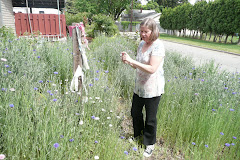
HOLLYHOCK DOLLS
--for Elaine & Karen
Pinch the blossom at the stem
Upside down, the multi-layered
bodice of green leaves
covers the modern woman
and the antebellum debutante.
Eight petals sweep the dance floor.
Now take the bud
and pinch it, carefully
leaving the stem in place.
Poke the stem into an upturned blossom.
Her face glows.
Her two eyes, demur--
natural and wild.
This turbaned woman
lines driveways, coy
about her alley roots.
Pinch another blossom
to give her skirts
south of the border color.
Women love fleeting moments.
Young girls take their cues
from grandmothers
showing them how
to dress and play and be.
Jim Bodeen
July 16, 2005--July 13, 2010
EVENING PRIMROSE
Night bloomers
A weed in a fence row
Yellow blossoms
Without manking
it wouldn't be an issue
but we're here
We better have fence rows
Mostly solitary
in upper leaf axils--
rarely in clusters
opening near sunset
Prairie evening, Desert, Missori Primrose--
What impulse helps you open?
What safety in darkness?
Insects call you from night grasses
Jim Bodeen
July 15, 2005--July 13, 2010

UNDRESSING FOR THE BEES
HOW DOROTHY ALICE'S BICYCLE COMES FULL CIRCLE
I. KAREN INTRODUCES ME TO JACKIE
This woman lived next door
to Grandma and Grandpa Everett.
She learned to ride on my mother's bicycle.
My mother's bike went to Sherman
an he learned to ride on it,
and when he was done with it,
it went to her an she learned
to ride on my mother's bike.
II. JACKIE SAYS,
She must have been baby sitting me
and I slept upstairs in her house.
It was exciting to go upstairs in that house.
My mother's mother died when she was a child.
My mother went to live in an orphanage
from the time she was 8 until 18.
She had a good experience.
She wrote a story about it.
It was a sad day when Dorothy died.
III. WALKING WITH KAREN BESIDE THE CORN
Mary Ellen told me Uncle Frank and Aunt Edna
wanted me too, after Mama died.
It's funny how things work out.
I was wanted in so many ways
nobody could say and I never knew.
Jim Bodeen
12 July 2010
New Ross, Indiana
DRESSING UP TO GO INTO THE BEEHIVE
--for Beth Binch
Long white pant legs dress me up on Sunday,
but this is a white cotton body suit
with a hard hat and netting
that zips me up from the neck.
Beth wants to guarantee my safety
while drawing on my fear.
Bees can smell your fear.
Look at them flying around out there.
Imagine the bee line you're going to make.
Bees come out and know where they're going.
Beth says her bees are in Corn Flowers,
Red Bud, pears and Dutch Clover.
She shows me the hive tool and brush,
explains how propolis glues hives together
to withstand weather, lighting wood chips
and dead leaves to go into the smoker.
Smoke alerts them to danger,
then calms them down. In a danger mode
they engorge themselves on honey, getting ready
for flight. I pull on white and yellow gloves
to the elbow. No way a bee can get you,
Beth says, putting me on alert.
Oh, what beauties! I love these ladies!
This is the world of royal jelly.
She holds two new frames we'll place
inside the hive to build the foundation of bee's wax
that will draw it all out in honeycomb.
This is what they love. Last week one hive swarmed
and left its population in half.
30-60,000 bees in a hive. She found the Queen
hiding under the hive. Another bee keeper
marked her. Look! she says, finding her Queen.
See her! The Queen is a marker.
They're active, brooding, repopulating--
making honey combs on frames.
My left hand's not strong enough to break
the hive from the propolis and lift.
Surprised by its weight I alarm the bees,
and Beth laughs and says, Back around
towards me on the other side.
Bees have a 3-mile travel distance,
stay in one flower all day. They do the bee's dance.
Don't work, fly, or navigate in rain.
Beth, they're sensing my fearmones.
You can't kill bees. It's against the law.
The swarm belong to nobody.
Bees are legally protected.
Nobody owns the bees.
Beekeepers share. My swarm.
Last week, somewhere else, in another hive.
Beth says she'll harvest some this year,
leaving bees plenty of honey for winter.
Commercial beekeepers can get greedy
and not leave enough for the bees.
They use too much pesticide.
Maybe 30 beekeepers in Montgomery County.
Beth keeps three hives of the environment.
If something happens to our bees
we have three years left. Beth takes off her gloves
to get a fingerful to give to me. I do the same
to take it from her finger. I must be vulnerable
to the bees to taste their nectar.
Jim Bodeen
11 July 2010
New Ross, Indiana
I. KAREN INTRODUCES ME TO JACKIE
This woman lived next door
to Grandma and Grandpa Everett.
She learned to ride on my mother's bicycle.
My mother's bike went to Sherman
an he learned to ride on it,
and when he was done with it,
it went to her an she learned
to ride on my mother's bike.
II. JACKIE SAYS,
She must have been baby sitting me
and I slept upstairs in her house.
It was exciting to go upstairs in that house.
My mother's mother died when she was a child.
My mother went to live in an orphanage
from the time she was 8 until 18.
She had a good experience.
She wrote a story about it.
It was a sad day when Dorothy died.
III. WALKING WITH KAREN BESIDE THE CORN
Mary Ellen told me Uncle Frank and Aunt Edna
wanted me too, after Mama died.
It's funny how things work out.
I was wanted in so many ways
nobody could say and I never knew.
Jim Bodeen
12 July 2010
New Ross, Indiana
DRESSING UP TO GO INTO THE BEEHIVE
--for Beth Binch
Long white pant legs dress me up on Sunday,
but this is a white cotton body suit
with a hard hat and netting
that zips me up from the neck.
Beth wants to guarantee my safety
while drawing on my fear.
Bees can smell your fear.
Look at them flying around out there.
Imagine the bee line you're going to make.
Bees come out and know where they're going.
Beth says her bees are in Corn Flowers,
Red Bud, pears and Dutch Clover.
She shows me the hive tool and brush,
explains how propolis glues hives together
to withstand weather, lighting wood chips
and dead leaves to go into the smoker.
Smoke alerts them to danger,
then calms them down. In a danger mode
they engorge themselves on honey, getting ready
for flight. I pull on white and yellow gloves
to the elbow. No way a bee can get you,
Beth says, putting me on alert.
Oh, what beauties! I love these ladies!
This is the world of royal jelly.
She holds two new frames we'll place
inside the hive to build the foundation of bee's wax
that will draw it all out in honeycomb.
This is what they love. Last week one hive swarmed
and left its population in half.
30-60,000 bees in a hive. She found the Queen
hiding under the hive. Another bee keeper
marked her. Look! she says, finding her Queen.
See her! The Queen is a marker.
They're active, brooding, repopulating--
making honey combs on frames.
My left hand's not strong enough to break
the hive from the propolis and lift.
Surprised by its weight I alarm the bees,
and Beth laughs and says, Back around
towards me on the other side.
Bees have a 3-mile travel distance,
stay in one flower all day. They do the bee's dance.
Don't work, fly, or navigate in rain.
Beth, they're sensing my fearmones.
You can't kill bees. It's against the law.
The swarm belong to nobody.
Bees are legally protected.
Nobody owns the bees.
Beekeepers share. My swarm.
Last week, somewhere else, in another hive.
Beth says she'll harvest some this year,
leaving bees plenty of honey for winter.
Commercial beekeepers can get greedy
and not leave enough for the bees.
They use too much pesticide.
Maybe 30 beekeepers in Montgomery County.
Beth keeps three hives of the environment.
If something happens to our bees
we have three years left. Beth takes off her gloves
to get a fingerful to give to me. I do the same
to take it from her finger. I must be vulnerable
to the bees to taste their nectar.
Jim Bodeen
11 July 2010
New Ross, Indiana
LACE CURTAINS AND BIRDSONG
.

PERSIMMON PUDDING
One time Karen came back
Uncle Johnny gave Karen a green persimmon,
Beth says to me in the pantry
off the kitchen where the desert table
gathers people like myself.
Beth walks me through sweet possibilities
of sugar and chocolate.
This is my Persimmon Pudding
and you top it with fresh whipped cream
from my cow, Beth says.
Two helpings later I ask her
about the rumor of home-made ice cream.
3 O'clock, Beth says, Seven flavors.
These persimmons grow inside a narrow band
of Indiana. Not to be confused
with California Persimmons.
Diospyra, fruit of the gods,
Putchamin, pasiminan, pessamin,
from the Powhatan, Cree and Mohican,
I'll find out later, from the family
of ebony--after my third dish,
after Persimmon Ice Cream,
after the story of the day,
where Karen finds how many ways
she belongs, teased and enticed
into being. How many ways
Karen became herself turning her story,
sweetening it, rich and rare,
farm cream for Persimmon Pudding.
Jim Bodeen
11 July 2010

EVERYBODY WAS YOUNG BACK THEN
Light and breeze in afternoon lace curtains
Silences in the house
Waking in a forest of birdsong
Look at that hand writing
May gold dust fall on us all in our talk
Our hands afterall full of star dust
Jim Bodeen
10 July 2010
PEELING POTATOES
Look here, Jim,
I planted Red Pontiacs,
Arvin says,
but these are purple.
They must be Caribe's
come up on their own.
I haven't grown
purple potatoes in years.
Jim Bodeen
10 July 2010
New Ross, Indiana
HISTORY, GRANDPA
ARRIVING IN SPRINGFIELD
Waiting for pizza, a man
approaches our table and says
this is the wettest June on record.
We drive by the Benedictine College,
and the Methodist Church readerboard
has only one thing to say:
Few of us need voice lessons
to sing our own praise.
I have not been so lucky.
A lucky Lutheran pastor emails how
his parents brought him here years ago.
We take the back road into Pittsfield
and walk into the Watson Hotel
where Lincoln stayed and I ask
the woman at the desk which room
Lincoln had, and she says
the one I rent to you.
Lincoln and Douglas
talked back and forth at each other
on the County Courthouse across the street,
soup made from boiling the shadow of a starving pigeon,
and the judge invites us to walk through
and take all the pictures you want
we're just talking.
The Tea Party has the biggest sign on Main Street.
When the Lincolns left Springfield for the White House
they had a yard sale. A big one.
My own scholarship on Lincoln holds up.
My favorite spot is the train station where Lincoln
says thanks and kindly let me be silent.
I don't know when I'll be back. F. W. Bowen
the RR supe wrote this note,
This train will be entitled to the road,
and all other trains must be kept out of the way.
Kerosene fueled de-icers and bamboo loops
to change schedules without stopping
hang on the wall. We walk Mr. Lincoln's
neighborhood, no cars allowed,
and inside the Lincoln house,
Karen reminds me,
I ran for Mrs. Lincoln
at Lincoln High School in Seattle
where she graduated in 1963.
Mr. Case, my 7th grade Language Arts teacher
taught me to diagram sentences and
When Lilacs Last in the Dooryard Bloom'd,
and if Lincoln had a weak eye it found Whitman's
on the street looking at him. My bow to apocrypha.
I could not have lived with Mary Lincoln
I wrote to a friend night before last
and the museum program goes to work
on my conscience but my assessment remains.
Ambition, high end spending, and Presbyterianism.
I'm ok with seances bringing children back to life.
Nora Titone's new book on sibling rivalry
in the Booth family stops me cold.
A poster claiming awareness of this problem
could have changed history, recounting her time
apprenticed in our major universities
provides my one Aha! experience.
If that's what literature's about I want none of it.
I make no major claims for the way I live as a poet.
Every day is just another day at first.
Ford's Theatre closed immediately
and didn't reopen for 103 years
with the performance of John Brown's Body in 1968.
Every little piece along the way did take place.
The funniest of phun has no context.
So much sorrow. Ringing laughter.
"An open field and a fair chance."
Jim Bodeen
9 July 2010
New Ross, Indiana
MOMENT
Before cattails and the flooding Missouri River,
Karen says, You can turn off your turn signal,
then laughs that little girl giggle.
Jim Bodeen
7 July 2010
HISTORY REPEATS ITSELF, GRANDPA
—for Kevin, poet of the post card poem
Chuck, at the Pony Express in Gothenburg,
gives me the story twice, after I return
from the Post Office with stamps.
Pony Express, a private company,
owned by Russell, Majors & Waddell.
Central Overland California and Pike's Peak Express Company,
out of Nebraska. Ten days to San Francisco.
Crossing the Great Plains from April 1860,
to October 1861. Put out of business
by the telegraph. Or railroad.
Horseback riders in relay stations.
This from Ehman Park, Gothenburg,
off I-80, full of mosquitoes,
while eating shrimp the day NPR
announces the Post Office request
to raise the price of first class stamps to 46 cents.
40,000 layoffs on the way.
Everyone paying bills by email.
Karen and I online 24-7 in the mothership.
No need to travel by horse or plane.
Maybe geography's still practical.
We share a history in relayed exchange.
Jim Bodeen
6 July 2010
Gothenburg, Nebraska
Waiting for pizza, a man
approaches our table and says
this is the wettest June on record.
We drive by the Benedictine College,
and the Methodist Church readerboard
has only one thing to say:
Few of us need voice lessons
to sing our own praise.
I have not been so lucky.
A lucky Lutheran pastor emails how
his parents brought him here years ago.
We take the back road into Pittsfield
and walk into the Watson Hotel
where Lincoln stayed and I ask
the woman at the desk which room
Lincoln had, and she says
the one I rent to you.
Lincoln and Douglas
talked back and forth at each other
on the County Courthouse across the street,
soup made from boiling the shadow of a starving pigeon,
and the judge invites us to walk through
and take all the pictures you want
we're just talking.
The Tea Party has the biggest sign on Main Street.
When the Lincolns left Springfield for the White House
they had a yard sale. A big one.
My own scholarship on Lincoln holds up.
My favorite spot is the train station where Lincoln
says thanks and kindly let me be silent.
I don't know when I'll be back. F. W. Bowen
the RR supe wrote this note,
This train will be entitled to the road,
and all other trains must be kept out of the way.
Kerosene fueled de-icers and bamboo loops
to change schedules without stopping
hang on the wall. We walk Mr. Lincoln's
neighborhood, no cars allowed,
and inside the Lincoln house,
Karen reminds me,
I ran for Mrs. Lincoln
at Lincoln High School in Seattle
where she graduated in 1963.
Mr. Case, my 7th grade Language Arts teacher
taught me to diagram sentences and
When Lilacs Last in the Dooryard Bloom'd,
and if Lincoln had a weak eye it found Whitman's
on the street looking at him. My bow to apocrypha.
I could not have lived with Mary Lincoln
I wrote to a friend night before last
and the museum program goes to work
on my conscience but my assessment remains.
Ambition, high end spending, and Presbyterianism.
I'm ok with seances bringing children back to life.
Nora Titone's new book on sibling rivalry
in the Booth family stops me cold.
A poster claiming awareness of this problem
could have changed history, recounting her time
apprenticed in our major universities
provides my one Aha! experience.
If that's what literature's about I want none of it.
I make no major claims for the way I live as a poet.
Every day is just another day at first.
Ford's Theatre closed immediately
and didn't reopen for 103 years
with the performance of John Brown's Body in 1968.
Every little piece along the way did take place.
The funniest of phun has no context.
So much sorrow. Ringing laughter.
"An open field and a fair chance."
Jim Bodeen
9 July 2010
New Ross, Indiana
MOMENT
Before cattails and the flooding Missouri River,
Karen says, You can turn off your turn signal,
then laughs that little girl giggle.
Jim Bodeen
7 July 2010
HISTORY REPEATS ITSELF, GRANDPA
—for Kevin, poet of the post card poem
Chuck, at the Pony Express in Gothenburg,
gives me the story twice, after I return
from the Post Office with stamps.
Pony Express, a private company,
owned by Russell, Majors & Waddell.
Central Overland California and Pike's Peak Express Company,
out of Nebraska. Ten days to San Francisco.
Crossing the Great Plains from April 1860,
to October 1861. Put out of business
by the telegraph. Or railroad.
Horseback riders in relay stations.
This from Ehman Park, Gothenburg,
off I-80, full of mosquitoes,
while eating shrimp the day NPR
announces the Post Office request
to raise the price of first class stamps to 46 cents.
40,000 layoffs on the way.
Everyone paying bills by email.
Karen and I online 24-7 in the mothership.
No need to travel by horse or plane.
Maybe geography's still practical.
We share a history in relayed exchange.
Jim Bodeen
6 July 2010
Gothenburg, Nebraska
THE PONIES' MOTHER

THE PONIES
When I say, Look,
the fallen horse on the street
swishes her tail
and releases a great loose fart.
When I look I see the ponies—
minutes new twins.
And the twins are us—
Karen and I—
not the twins we raised,
but the two, tired and wet
that are us, in the back end
of the station wagon being born,
where the motherhorse just gave birth.
Slick wet still in our mother's soothing smooth skin.
Our mother who brought us here
thumps her tail,
a happy dog.
Jim Bodeen
7 July 2010
Nebraska City, Nebraska
WHO SHALL I SAY
Our old Victorian house
built by the Great Northern Railroad
across the street
from the Lutheran Church
didn't give any ground,
matching God's place
dormer for dormer, height and roofline,
counterpoint to parallel mission.
God calls, but he doesn't call
everyone, the pastor said.
This North Dakota Lutheran Church
gave me to God saying this to me,
a boy listening.
You'll know if he calls, the pastor said.
I could hear my father's cries
from our fenced yard,
his blood cold and blue,
feet soaking in water,
iced from North Dakota winter.
My mother cried too, helpless,
I don't know what to do, Wayne.
What can I do?
I was the boy, and I heard.
Behind our house, a barn,
and in summer, Indian Tobacco,
and a peace pipe from a souvenir store.
A marked boy, chosen by no man.
Jim Bodeen
5 July 2010
Little America, Wyoming
LIVES AND DEATHS OF MASSIVE STARS

SOLAR LISTENING UNDER A NIGHT SKY
Fireworks in the sky during the independence time.
The clear dark moon arrives later.
Venus, Saturn and Mars as a red dot.
The Skywatcher's an obsessive mirror
on a revolving platform built on non-drifting sand dunes.
maintained by constant wind
leftover from the Bonneville Flood
some 15,000 years ago.
Look down, look up.
Before the geologist and the astronomer,
what would Walt Whitman say to this—
exploding white dwarfs,
the lives and deaths of massive stars.
●
Irwin Horowitz, the astronomer, explains about the two types of supernovae: Type I with no hydrogen absorption, and accompanying light curves; and Type II, classic exploding stars with hydrogen. "Type I gets so big it explodes and obliterates itself. A big hydrogen bomb, Type II collapses under its own core under gravity."
He poor/He rich—the unexplained scientific code language on his overhead chart. We're all searching through the same story line, doing the same work.
"The life of a star is a balance between pressure and gravity. The pressure tries to blast the star apart and the gravity attempts to crush the star inward. The pressure grows as you go toward the center of a star, much like an onion. The struggle is for balance."
As one travels inward, the hotter the gas. The massive star consumes its fuel faster and faster to obtain higher temperatures. Our sun is a bit odd in that it has no companion, no white dwarf in accompaniment. Too small to be a supernovae. A giant nuclear reactor, fusing hydrogen, producing helium and energy.
●
We leave Yakima at 7 am listening to the voice of young June Carter Cash, clear calling and yearning from the person who would find her soulmate in Johnny Cash. June Carter Cash, a scrapbooker, memory collector, from deep country gospel roots, dancing on a pony keg, fevered, going to Jackson. The music will switch to Cajun BeauSoleil, warming us towards deeper hope and intimacy. Karen loves the fiddle. She laughs at my French.
Prelez-nous a Boire. Speak to us of drinking. Tous les doux pour la meme. For the same girl. J'ai ete au Zydeco. I went to the Zydeco.
Boys from small towns. Apprenticed to become North Dakota slow talkers.
We will turn off I-84 at Mountain Home, Idaho, listening to Garrison Keillor's Prairie Home Companion, coming from Chicago, and Keillor's clearly off-balance from the songline image of John Prine's "...you've broken the speed of the sound of loneliness." Prine is Keillor's special guest. "How did you do that?" Keillor asks Prine, and Prine, a throat-cancer survivor, voice cracking, laughs. Prine sings, "Grandpa was a carpenter..." and Keillor asks him about his grandpa, his carpenter skills. "He would build a house and move on. Grandpa was a Lincoln Republican." Lincoln still very much alive. "He kicked my dad out of the house for voting for FDR." "And chainsmoked Camel cigarettes?" One can imagine Keillor looking into Prine's shirt pocket. Prine laughs again. "Well, I sang that song at a family reunion, and my cousin pulled me aside afterwards, and said, 'Johnny, he smoked Kools. Grandpa smoked Kools.' But that was a one-syllable cigarette and I needed a two-syllable word."
Prine carried the mail in Chicago. He's one of us. The radio cracks and we lose contact as we drive into Bruneau Dunes State Park.
●
Karen has this trip planned to roughly 400 miles a day. We want to be in an area without a spot. Without a fixed destination. This is the tension that creates us. A spot to look around in and maybe something will happen. A spot that is not a spot.
Karen's the lead story. Our story walks in solidarity with the past. We step aside for memories to surface. The seminal journey of our young marriage came in 1979 when we followed this road with our young family, coming back to Indiana to get that children's rocking chair saved for Karen (but she had to come back to Indiana to get it), to find and take the peonies from Karen's mother's grave, Dorothy, Karen's mother, gone at one, to claim the narrative of Karen's story. Our three children—Tim, 8; and the twins, Krista and Leah, 5. Karen and I were 34 years old.
●
"Big stars need to maintain their luminosities," the astronomer tells us. He talks of time in a way that would take the breath from geologists. Short time. Long time. "Short, spectacular light consuming fuel at massive rates."
And temperatures. Our daughter calls to tell us of her child's fever. "She has a temp of 102.6." The astronomer says, "One billion degrees Kelvin."
"You can't get any more energy from iron," he says. "Fusion releases energy. Iron is the end point of the star."
John Coltrane, energy before fusion. Coltrane, the birth story. Music before music. What was music after Coltrane? Must we forget him in order to hang on to the thread of sound?
"How does inward core collapse lead to outward explosion? The outer core lags behind the inner core."
●
Karen and I walk to the observatory through a trail of sand. Only red flashlights allowed tonight. We didn't know we were coming. No red flashlights in my backpack. Karen will figure out these telescopes, and how to look through them. I want to walk that lonesome sand dune at dusk before the presentation. Neither of us have thought about bugs or mosquitoes, and that means we'll both be back in the mothership by nightfall. Karen will stay, and I'll put on spray and long sleeves, try to figure out how I'll walk the sand trail by starlight. Even at midnight the moon will not have arrived.
●
"How the universe works—supernovae creates it all. We're all made from dying stars. We are literally star dust. The heavier the star, the faster it burns. Live fast to die young. Building blocks of the universe, trapped and they need to get out. Iron eats the energy of nuclear fusion."
Language massages the soul as it makes its assault. Short clips interspersed from the Discovery Channel's Nova animates the presentation, gives me the odd detail to hang on to in space and time. I'll take some of my questions to the Internet, logging on to a student site suggested for 14 years and up. The astronomers can't contain themselves for joy. I'm certain that I've just heard that the star dust in my left hand might have come from a different star than the stardust in my right hand, but language is on the move, a migration that can't be understood or legislated. Thanking the stars for my left hand, I ask, But which one?
Life in space with no transitions.
Chinese astronomers observe the Crab Nebula in 1054 A.D. Western observers aren't looking at the sky, don't see it. This detail is important to our story, making it necessary to rewrite the textbooks. Make a note and look for it later. Catch the fragments that will give your own dreamstory some air. Explosions are perfect markers. Pay attention to the sky. What the Chinese astronomers saw in 1054 is still news. That, my friends, is poetic theory.
Neutrinos hold the answer for the missing energy.
Early computer models couldn't make the stars blow up. What was missing? Where was the missing energy? Neutrinos. But how to prove that supernovaes produce neutrinos? Neutrinos are the smoking gun in the room. Finally we saw it: SN2008D (09 Jan 2008), a star in the process of blowing up.
Prove that supernovaes produce neutrinos. Remember those Chinese.
Dark energy is discovered in 1998. Here comes the shadow. 14 billion years ago the big bang. Still expanding. Galaxies flying away from us. Explosions are perfect markers. In 1998 we get the big surprise of dark energy, but we don't know what it is. It is this, though—every textbook is wrong and will need to be rewritten. The dark energy can't be seen, touched or detected, but it says that the universe is speeding up, not slowing down. It's the number one problem in physics right now.
We call it dark energy because we don't know what it is.
Poets have the same problem.
●
Walking the sand trail through sage under starlight on the way back to the mothership with no red light, I'm dizzy, and force myself to pay attention. Don't walk off. Don't twist an ankle. Stay in sand. It's a slow, wonderful half-mile. I don't stay to look through the telescope. Our park volunteer reminded us, "Don't be afraid to tell us if you don't see anything. Sometimes we move the scope. And you've been waiting in line for 30 minutes." I walk back by sand feel, alone. I arrive back at camp to find that Karen has left the porch light on for me and a swarming mass of over-sized mosquitoes have gathered to greet me uner the light. This is serious enough me make me question the practicality of attempting entry. What to do? What a night.
●
On the way out of the dunes campground, I stop to cut sage in full summer flower, in all of its musky headiness. I think first of the young volunteer at the telescope in the Ole Miss sweatshirt. A lawyer in the air force. His folks have a place on the beach in Alabama. He shares their disaster narrative with me. "BP shut down the beaches. The government shut down the drilling." He tells me to go eat with the people, and listen. And last night, unable to sleep, killing mosquitoes that gained entry with me, secret knowledge accessible to all, buzzing my head.
Karen reads to me from an interview with a Wyoming geologist as we drive. I go in and out of all of it, eyes skimming the road, sweeping the field.
Look down. Look up.
Crossing fossil fields on the highway.
Countless millions of tiny critters
give their lives
so their transformed bodies
can be changed into oil
to fuel my rich life.
Rock Springs and Green River.
Fossil Butte and night sky.
Fossil Fish Karen says aloud, reading.
Fossilfish. Fossil Fish.
Several times. Gift from Karen.
How I hear it both ways
at the same time.
Gift from sea world.
Fossil Fish.
It's against the law
to pick up fossils on federal land,
Charlie Love says, but it's hard
to walk 100 yards from your car
in SW Wyoming and not be able
to find fossils of some kind.
"There are places you can
quarry fossil fish all day
and keep them." Fossil fish.
"It's a great deal of fun
cracking open a piece of shale
and finding the imprint
of a fish 100 million years old."
Jim Bodeen
3 July 2010- 6 July 2010

●
Who by Fire
CHAPPELL, NEBRASKA
While the Internet shows
lakes and state parks for campers
the grain elevator and water tower
emerge from the community
of trees that secures and holds
this town, larger than the one
we're driving to, and a small city
compared to the one I come from. I know
the park will be pristine,
that young people are online
all over the world. We stop here.
Karen showers while I bathe
Sadie. We walk to town
crossing tracks, stopping
at the Red Rooster where
the waitress takes our photo
sitting at the counter. Her
step son is a barber out west.
We walk back to camp crossing
the path once belonging to all.
Jim Bodeen
5 July 2010
LITTLE AMERICA
Somewhere in the picture book
of her childhood, Karen rode
in the back seat of her uncle's car
reading signs promising
an entire country
just so many miles ahead.
Little America, the signs said,
offering hope to children
of a place unblemished by adults.
Not humor, like Burma Shave,
but oppositional—
Oasis. Cards. Souvenirs
providing real transportation,
all under the master umbrella
of respite and certainty,
for children pulled back and forth
by uncertainties, wondering.
But no memories of this place.
Not one detail. Only those two words,
Little America,
pulling and tugging.
She's back tonight a half century later.
Little America on the 4th of July.
Sunday. Clean showers. 50-cent cones.
Camped in the parking lot
off I-80. Wyoming oil country.
The mother of all truck stops.
No hookups for a riverboat like ours.
No charge, either.
We share a quesadilla.
We walk Sadie between trucks
licking our cones.
Jim Bodeen
Independence Day, 2010

ALL I'LL EVER KNOW
—for K
Show me the photo of Karen
in fourth grade with her hair
in curls, holding her hands
before her cheek
elbows on the bench
as the photographer instructed
the one framed in her sewing room
that makes me dizzy
trying to get her story right
a full decade before
she opens the door
and I make the only
promise that matters
That photograph
and I'll run the Mississippi River
to the Delta in old age,
wetlands, estuary, nursery—
Here I kneel before the rocking chair
grandchildren fight over
that moment
before the door of forever
Jim Bodeen
3 July 2010
MO(U)RNING BLESSING
The mothership is a riverboat
on oil's highway Your dreams
from last night included
everybody's greatest hits
every room in your house
full of the young
and shamans of every shape
and stripe brought their goods
Ring the bells someone said
and bells sang for all
food in frozen displays of excess
reminding us of the hunger
that cannot be cured
I hold a large spoonful of mashed potatoes
before my mouth
w.s. merwin be my guide
constant contact with karen
in other rooms
when birds testify we'll all sing
in the choir of the called
Jim Bodeen
3 July 2010
KAREN'S SHOES
Loading the mothership,
exhausted, Karen's just about asleep
as I enter the bedroom
with one last question,
"What did you take for shoes?"
"Yes." "What?" "Lots."
I pick up a pair of sandals
and return to the ship
to put my pair away.
No room here, I say,
seeing Karen's shoes.
Impressive work.
Jim Bodeen
3 July 2010
ANESTHESIA
Brings its own forgetting
erases what you want to know
you still believe
in something other
than your future
Your friend is gone
Live with your dis-ease
Jim Bodeen
3 July 2010
WHO GOES
—for p.l.
is who I'm talking with
No ahead or behind
all beginners
practicing—
both ways count
both the same
only breath takes
Oh, the breathtaking!
Principiantes
Those on the way
Those I watch for
listen to
Jim Bodeen
30 June 2010
Subscribe to:
Posts (Atom)

 Posts
Posts